As weeks go, you could say it was semi-Shakespearean. Sound and fury? In abundance. Signifying … what, though? That’s the hard part. Nothing? Absolutely not. Certainly something, maybe even everything. Who can say?
It was a week about the past and about the future, focused on celebrating history and also impacting it. Reminiscing and prognosticating, cherishing and dreaming.
It was, altogether, pretty common.
And in the midst of everything — six games from Monday, Aug. 3, through Sunday, Aug. 9 — the 2026 Yankees went 3-3. So much to see here. Just not, you know, right now.
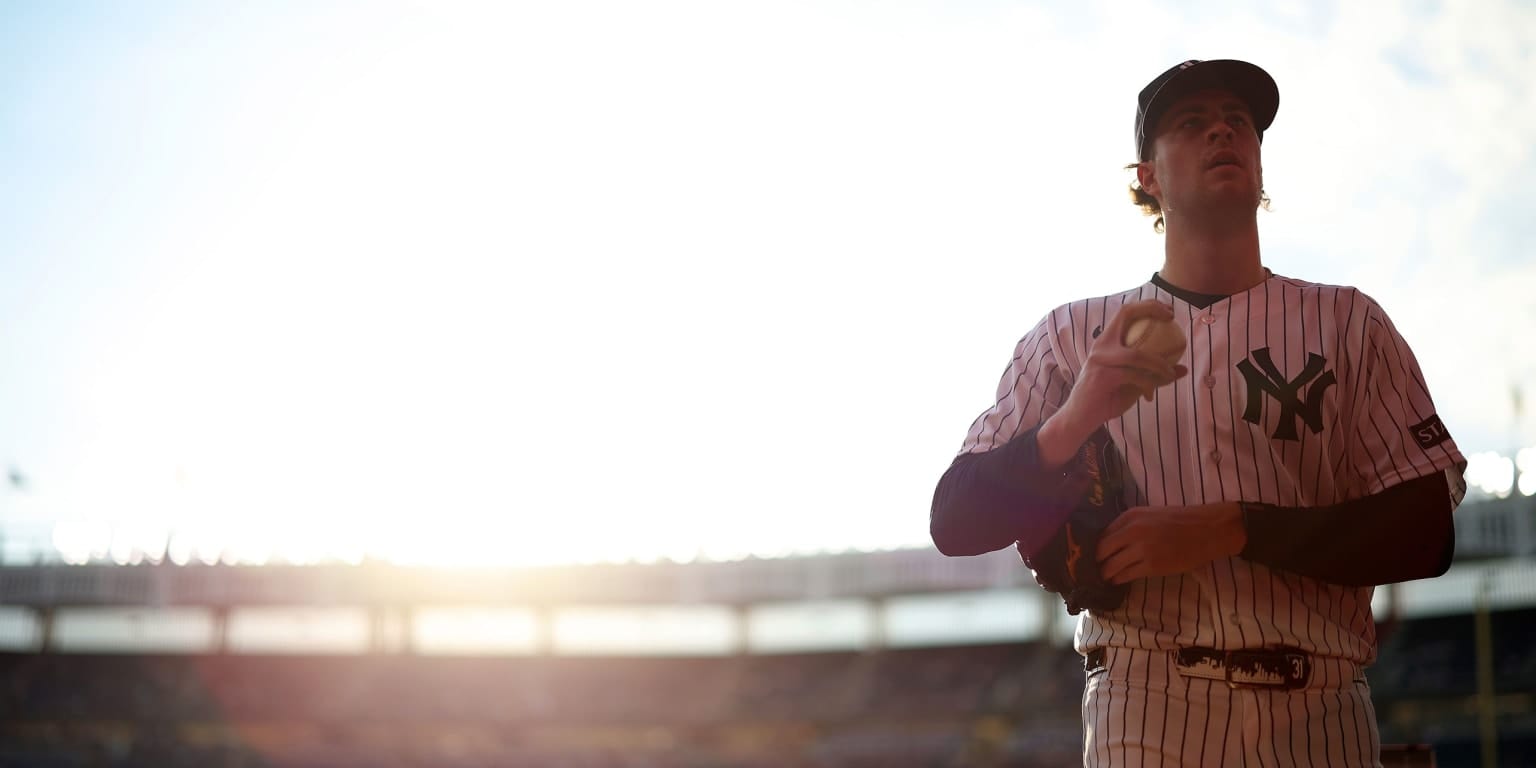
Cam Schlittler has often been front and center these past 15 months, ever since he debuted in July 2025 and then, that October, put on a show for the ages against the hated Red Sox that he grew up adoring. It was a winner-take-all American League Wild Card Series game, and Schlittler took it. Baseball fans — especially those in the Bronx — have seen a lot in the past 120-plus years, but never a postseason start quite like that one.
This week, though, Schlittler was a bookend. He pitched the first and last games of the stretch, remarkably different performances with frustratingly similar outcomes. Such is the life of a starting pitcher. For all their work studying the past and trying to change the future, the present, too often, is almost an afterthought. So it was during this week in early August. Amid the trades, the callups, the injury news, the varying forms of emotional returns, there were nine innings a day that seemed to fly beneath the radar. Part of that is the nature of the New York Yankees, the team with more than twice as many World Series championships as any other in the league. Yankee Stadium is a museum to the sport’s past as much as it is a venue where that history continues to be written. And part of it is the mentality of the modern sports fan, overflowing with contextual information.
And then there’s Schlittler, the beacon of the present, a man for whom past and future barely register, even as his every start demands that fans pay attention to what it means for the future, and what it says about the past. The paying customers connect dots from one start to another, trying to understand what it all means, but Schlittler, it seems, has forgotten about the past and doesn’t bother with the future. “I’m trying to figure out how to word this,” says Yankees pitcher Ryan Weathers. “Like, he doesn’t care, but he does care, if that makes sense.”
If you want to discuss Schlittler’s mindbogglingly rapid ascent from a largely unknown arm to a favorite for this year’s AL Cy Young Award, you might want to start right there. Schlittler, himself, is perfectly fine with the description, unconcerned about how it might sound.
“I’m sure the guys can tell you, like, I really do not care,” Schlittler says, unknowingly echoing Weathers’ own words. “And they don’t care either. Like, they trust me to go out there and do my job, regardless if I just had a good one or a bad one. I don’t hang on to that stuff.”
It might seem like a dangerous statement for a professional athlete to make, the type of comment that sets emotions ablaze. We want our heroes to care. We want it to mean as much to them, in exactly the same ways, as it does to us. “Not caring” might be the cardinal sin of the modern athlete, a stereotype of the greedy, overpaid ingrate.
Except, of course, that’s not what Schlittler is saying, nor is it what Weathers is implying. Schlittler cares deeply about everything he does, and he has the stats and metrics to back up the fact that his process is working. It’s just that he won’t stand for letting yesterday mess with today. And he won’t let tomorrow interfere with what he has to do right now. He can prepare like crazy for a start, and he can hope that the fielders are in the right spots, that the umpire calls the pitch correctly, that the bat makes contact with his offering just far enough away from the sweet spot. He works his tail off to get results, and thus far, they’ve almost always been great.
“He does a good job of taking the feedback after outings and internalizing it and putting it to use during his work week, but not letting it consume him,” says pitching coach Matt Blake. “And I think that’s the important part, too. There’s got to be a steadiness to the work that you do.”
Schlittler is nothing if not steady. “I’ve known Cam since we were drafted,” Spencer Jones, the Yankees’ first-round pick in 2022, says of the team’s seventh-round selection that year. “He doesn’t take too much stock in the past. He works hard for what he’s got. That’s one of his great qualities, is that he’s able to flush things in the moment and then get back to what he does really well.”
That ability manifests itself in the profoundly easygoing manner in which Schlittler carries himself. There’s an air of unflappability, one that matches the couldn’t-care-less mentality he espouses. Far from gruff or indifferent, he just seems … content.
It’s a far cry from how he appeared last July, when he was called up to take Clarke Schmidt’s place on the roster after the pitcher hurt his elbow and would require Tommy John surgery. Ahead of his first big league start, against the Mariners on July 9, Schlittler paced around the home clubhouse, seemingly unaware of where he was supposed to be or how he was supposed to pass the time. Pitchers have the run of the facility on their start days, able to control the music and hide out wherever they want, but Schlittler seemed like a lost puppy, albeit a very tall one. Schmidt, who as of this week was still rehabbing from the injury that precipitated Schlittler’s callup, says that his teammate doesn’t quite have the “what-me-worry” nonchalance on a start day of a CC Sabathia, but neither does he demonstrate the cold, moated quality of a Gerrit Cole.
Or, as manager Aaron Boone describes the Massachusetts native: “Chill. With an edge.”
Schlittler loves his manager’s assessment, even strives to realize it. That chill can be a superpower. It presents as resolve, or fearlessness. If you didn’t know better, you might see aloofness, but it’s actually comfort, a remarkable asset for a player still so early into his career.
Heliot Ramos, acquired from San Francisco at this year’s Trade Deadline, is one of just two Yankees who has faced Schlittler, along with fellow newcomer Luis García Jr. Ramos knew about the pitcher who had shut down Boston in the postseason the previous fall, but between that date and the Yankees’ Opening Series of the 2026 season against the Giants, months had passed. The pitcher that Ramos saw on the mound at San Francisco’s Oracle Park in the second game looked as fierce as he had in the October crucible.
Ramos has been around long enough to know that players have alter egos, that the on-field persona doesn’t necessarily match the clubhouse vibe. Still, Schlittler presented a particularly stark contrast. “Obviously when you’re playing against each other, it’s kind of like they see you as the enemy,” Ramos says. “When you get to meet them and you get to know them, they’re super goofy.”
Schlittler is anything but goofy on the mound. Standing 6-foot-6 and taking advantage of everything that extension offers, he wows with four different pitches, three of which fall under the “fastball” category. There’s the triple-digit heater and the biting two-seamer, and both are terrific weapons. But then there’s the cutter. That’s the unicorn.
It’s a pitch that he throws in the mid-90s, with five-plus inches of vertical break and a slider-like horizontal sweep. “The other day, I was watching his bullpen, he threw it through that tunnel, and it looked like it rose,” Weathers says. “It looked so weird. I can’t imagine being in the box when he just busted you with 98 to 100 mph four-seamers, then he throws 94 and it just goes up-chute. It actually moves like a slider. That pitch is crazy.”
Schlittler remembers tinkering with the pitch in the bullpen two days before a Double-A start. Yankees director of pitching Sam Briend was watching that day, and he told him that it looked good enough to use in the game, so Schlittler threw it in his next start, then was promoted to Triple-A that night. He rode the pitch hard for the next year as it continued to evolve, and then worked with Cole on ways to make it even better, eventually putting even more velocity behind it.
“It’s definitely an outlier,” Schlittler says, but then again, so is he. “I feel like I goof around for four days of the week. And then I pitch, and I’m locked in. I show up here, and I don’t really talk. I do what I need to do, and I go out there and try to dominate.”
The dominance? That’s the edge. And it was on full display against the Red Sox last October.
Schlittler doesn’t love to talk about the Boston stuff, and you probably know the details already anyhow. The constant social media barrage leading up to the deciding game, the threats against his mother. “I used to be one of those fans,” he admits, saying that he understood them well enough to become almost immune to any personal attacks. “I’m like, ‘Dude, they have no idea what they’re going to bring up.’
“Because I know. There’s no way that I was going to fold in that situation, regardless of how much pressure there was. … I got really good sleep, and I woke up and I was locked in. People are trying to ruin my life before the game, and it’s like, I don’t care.”
His phone suddenly a minefield, Schlittler sat with the Yankees’ head of media relations and started laughing. Then he went out and pitched eight shutout innings with no walks and 12 strikeouts. It was a stat line that had never been posted in MLB postseason history, and he did it in his debut.
Was there some extra weight attached? Sure, Schlittler acknowledges that it was a big game. But there was also some zen at play. Looking back, he recalls that he had nothing to lose. If he got shelled, they would have said he’s a rookie in too big a spot. Things happen. And it’s not like the Red Sox fans were going to tip their cap to the local kid pitching for the enemy either way. The pressure was fun. It was exciting.
“I think the biggest thing is, ‘OK, someone’s season is going to end today, but I have to go home to Boston,’” he says. “Like, there’s no way that I’m going home and taking [that stuff] for four months. To go home and deal with that? I was like, I’m not doing that.
“And I hate talking about it because fans get so wound up. But at the end of the day, I went out there, shoved it up your … and that’s kind of just the end of it.”
So … maybe not so chill. Except, and it’s hard to describe this, Schlittler talks about that night with a casual cool that seems impossible, like he’s talking about someone else doing something he once read about. Maybe it’s because he struggles to find the words to explain that moment’s importance. There’s value in delivering in that moment, both for the team and also for your career. Ask anyone in the Yankees’ clubhouse, and they’ll talk about the virtue of confidence, of believing that you can do something. But there’s a difference between believing and knowing. Thinking you can isn’t the same as showing you did.
“There’s a certain amount of confidence to be gained by performing near your best in the toughest situations,” Cole says. “When [you’ve done it,] you just can objectively tell yourself, ‘I’m capable of doing this.’ Before that, you have to kind of believe that you’re capable of doing it.”
But baseball has little time for the narrative, even as we regularly turn the sport’s on-field moments into heroic fiction. Schlittler has seen less in his big league career than his veteran rotation-mates, but enough to understand how unforgiving the sport can be. That remarkable performance against Boston? Well, what if it hadn’t been enough? He’s quick to point out that it’s a great story because the Yankees’ offense showed up that day, without which, there’s no Champagne celebration, no great memories to be mined. He has seen the Yankees win on days when he has had pedestrian pitching lines, and also shrugged off tough losses following nearly flawless performances.
“I was that guy against Toronto,” Schlittler says of his second and final 2025 postseason start, when he took the mound for Game 4 of the 2025 ALDS against the Blue Jays. “I pitched fine. But our season ended, and I was the one who pitched. And I let up the runs.”
You don’t get to pick and choose which starts you dwell on and which you don’t, but “I think he holds himself to a really high standard,” Blake says. That standard manifests itself in Schlittler’s performance, no doubt, but also in his refusal to make any one outing — good or bad — bigger than it needs to be.
“I feel like I flush things really quickly — I don’t care,” Schlittler says. “I have a good one, I have a bad one, I don’t care. A day later, that outing’s over. It’s over. I’m already preparing for my next start. Who am I facing?
“It obviously helps that I pitched well [against Boston]. I’ve done something that no one’s ever done. But it’s more about the experience of it, what I took from those few weeks that I was able to take into the offseason.”
Experience was a treasured commodity around the Yankees during that first week of August this year, when so much changed at the same time that nothing really did. It probably helps to map it all out.
On Monday, Schlittler pitched against the Cardinals, but the day’s real news was the Trade Deadline, as general manager Brian Cashman sought to finalize the roster that would attack the stretch run and hopefully offer a jolt to an injury-plagued offense, sluggish instead of slugging. The next day brought another game against the Cardinals, but first the promotion of top prospect George Lombard Jr., the dawn of a new era. On Wednesday, while fans were getting ready to head to the Bronx for the third of three against St. Louis, eagle-eyed reporters noted that Aaron Judge was on the field running for the first time since he went on the injured list with a broken rib at the beginning of June, triggering an offensive swoon that lasted two-plus months.
Thursday was an off-day. Breathe.
Friday, the Braves came to town riding an eight-game winning streak after having come out of the All-Star break on fire. Max Fried, who missed the opportunity to pitch against his former team in 2025 due to an injury, would be on the hill for what was sure to be an emotional night. Saturday? How about Cole versus Chris Sale, a matchup between two of the most dominant pitchers of their era? But also, Old-Timers’ Day, the type of Yankee Stadium celebration that inevitably sucks up more than its share of oxygen. The guys who came back owned a combined 89 World Series rings, each with a story and a memory that today’s players are chasing.
And finally, Sunday. Just a baseball game against one of the best teams in the league.
Schlittler’s two starts, on Monday and Sunday, couldn’t have been more different. In the first, he had the rare misfire. Three innings, four runs. He struck out six, but he walked five — a completely uncharacteristic loss of control. The Cardinals raced to a 6-0 lead and the Bronx faithful grumbled, but then the Yankees’ bats woke up, and García Jr., acquired the night before from the Washington Nationals, hit a two-run blast in the seventh inning that put his new team ahead, 7-6. In the top of the eighth, though, the Cards scored seven runs and held on to win, 13-7. The Yankees’ offensive outburst went for naught.
On Sunday, Schlittler took the mound with the Yankees looking to sweep the Braves, and he was, to put it bluntly, extraordinary. Everything he couldn’t do on Monday, he did the next time out. Seven innings. Eleven strikeouts. Zero walks. The one hiccup came late, a solo shot in the seventh from Matt Olson. And although the Yankees tied it and forced extras, the Braves pulled out the win to salvage the series.
Six games, each seemingly with more intrigue in the hours leading up to the first pitch than in the nine innings on the field. The past and the future were all fans could talk about, all while the 26 guys on the roster had to do their part to remind everyone that this is really all about the present as much as anything else. If the Yankees are going to make history and create memories for the next generation of fans to celebrate, it will be because of what they do for what sometimes mistakenly feels like the three least important hours of the day. As Cole — a lifelong Yankees fan and someone who genuinely cherishes the franchise’s history and its legends — put it, his start against Atlanta had very little to do with the Old-Timers’ Day celebration that preceded it. “We lost the last series, and we have to win this one,” he said.
And maybe it would be easy, as a result, to draw some sort of conclusion from the difference in two Schlittler starts, one objectively a mess, one exceptional. For narrative-makers, we want to see an angry pitcher looking to compensate for a prior failing. But he won’t bite. Mostly, if you push him, he’ll admit to wondering why his worst starts come at home and his best starts on the road. Is there something about showing up to the park directly from the hotel that makes him more efficient? He’ll also consider if he got caught up in the swelling noise around the Trade Deadline, and if that impacted his mental preparation for the Cardinals.
But bringing the emotions of a bad start into his next outing? No way. “They trust me to go out there and do my job, regardless if I just had a good one or a bad one,” he says. “So, I don’t hang on that stuff. And that stuff can really mess you up if you do, especially playing in New York. You could have 20 good starts, and then you have one bad start, and the fans are going to freak out.
“If you let it get to you, you’re not going to last long here. The fans do not care what’s going on. You’ve got to go out there and perform every day. And if you can’t do that, then you’re not going to be here long.”
Schlittler hasn’t been here for very long, but there’s no reason to think he’s going anywhere anytime soon. He has already won and lost in the postseason and confirmed whatever belief he needs to have in his ability. And either way, October is not on his mind. The pitcher is thinking about today. He doesn’t care about what he did yesterday, and he doesn’t care about what he has to do tomorrow. And as crazy as it might sound, a pitcher who doesn’t care about anything might be the best thing a team with the Yankees’ aspirations could hope for.
Jon Schwartz is the deputy editor of Yankees Magazine. This story appears in the September 2026 edition. Get more articles like this delivered to your doorstep by purchasing a subscription to Yankees Magazine at www.yankees.com/publications.