A few years ago, boxing was abuzz about a quartet of talented lightweights all primed and ready to face each other for years to come. The so-called “Four Princes” of Ryan Garcia, Gervonta Davis, Teofimo Lopez and Devin Haney were young and supposedly hungry to prove who was the dominant force at 135 pounds.
However, the foursome have only fought a paltry two bouts against each other thus far. Davis knocked out Garcia in seven rounds in April 2023, and Garcia beat Haney by majority decision the following year at super lightweight. Garcia’s victory was later changed to a no-contest after Garcia tested positive for performance-enhancing drugs.
Advertisement
Since then, all four except for Davis have outgrown the lightweight division and are now competing 12 pounds heavier at welterweight. Yet despite being in the same division once more, this writer would be surprised if any of them end up sharing the ring again beyond what’s already being discussed. There’s simply too much politics and ego standing in the way.
As disappointing as that recent crop of lightweights has been, there was once a time when the division featured three future Hall of Famers who were willing to challenge each other more than once to prove who was superior.
Bob Montgomery, Beau Jack and Ike Williams.
Montgomery was born in 1919, in Sumter, South Carolina, and he followed his brother to Philadelphia as a 15-year-old. In the “City of Brotherly Love,” Montgomery found work pulling clothes out of industrial-sized laundry machines. He also started boxing as an amateur at a gym known as “The Slaughterhouse,” which tells you all you need to know about where “The Philadelphia Bobcat” first learned to ply his trade with gloved fists. When he later turned pro, Montgomery was managed by Joe Gramby, Philadelphia’s most influential Black manager and a Pennsylvania Boxing Hall of Fame inductee.
Aug. 4, 1947: Bob Montgomery rests on the ropes during training for an upcoming bout with Ike Williams.
(Keystone via Getty Images)
Jack was born next, as Sidney Walker, in Waynesboro, Georgia, in 1921. After his mom died when was a kid, Jack moved to Augusta to live with his grandmother, who gave him the name Beau Jack. As a young boy, Jack worked by shining shoes at the Augusta National Golf Club, home of the coveted Masters tournament. It was there that Jack competed in many “Battle Royales,” where he and other young Black boys were ruthlessly pitted against each other by white organizers, often blindfolded, until one remained standing.
Advertisement
However, something positive came out of that harrowing experience as it led him to pivot from shoeshiner to caddie at age 18, where he was noticed by club founder and golf legend Bobby Jones. It was Jones who helped rally the club’s members to fund Jack’s nascent boxing career.
Like Jack, Williams was born in Georgia, in the city of Brunswick in 1923. At the age of 9, his parents separated, and he moved with his mom to Trenton, New Jersey, where he first started fighting in the streets to defend his turf as a newsboy. The future “Trenton Tornado” began boxing as an amateur at a local gym under the tutelage of former fighter Jesse Goss. In addition to excelling at boxing, Williams was also a varsity athlete on the track and baseball teams at Trenton Central High School.
What united Montgomery, Jack and Williams were their hardscrabble upbringings during the Depression. All three had to scrap, literally and figuratively, to support themselves and their families, and all three turned to boxing for greater earning potential.

Jan. 4, 1946: Beau Jack (left) winds up for punch against Morris Reif. Jack won via early knockout.
(Bettmann via Getty Images)
To gain an appreciation for their in-ring styles, we can turn to renowned historian Bert Sugar. In his book titled “Boxing’s Greatest Fighters,“ Sugar rated Jack No. 52 out of 100.
“Barreling into his opponents like a pinwheel out of control, Beau would provide enough smoke behind the fire to suffocate his foes, causing them to suffer gentle and gradual erosion,” described Sugar. “Looking like a marionette with one string broken, Beau flailed away from every conceivable angle, his low-held hands throwing a smorgasbord of punches, bolos, hooks, crosses and just about everything else imaginable with either hand.”
Not far behind Jack in Sugar’s top 100 was Williams at No. 60, who, standing at 5-foot-9, was an exceptionally tall lightweight. He was a boxer-puncher equally capable of using his reach to stymie his opponents as he was to tear into them with violent combinations. Evidenced by his 61 career knockouts, he was more than willing to choose the latter approach.
“With well-defined moves worthy of some of the old-time greats,” said Sugar, “Williams used his lightning left to run interference for one of the heaviest rights in lightweight history, leaving most of his opponents with the same difficulty in their search for defensible borders as ancient Rome.”
Although Montgomery didn’t crack Sugar’s list, he, too, was an impressive specimen. The fifth edition of “The Boxing Register” states that Montgomery “won acclaim for his aggressive, take-no-prisoners approach. His intense boxing style led sportswriter Johnny Webster of the Philadelphia Inquirer to dub Montgomery the ‘Bobcat’ because of Montgomery’s way of continually moving forward and pawing an opponent until he got them.”
Advertisement
It was Montgomery who was the first to turn professional in 1938, followed by Jack in 1939, and Williams in 1940. When all was said and done, the world-class triumvirate fought 10 bouts between 1943 and 1955, five of which were for the lightweight title.
In doing so, they set the division ablaze with bravura performances that attracted huge crowds across the country.
1943: Bob Montgomery vs. Beau Jack I and II
The first fight among them was between Montgomery and Jack on May 21, 1943, at Madison Square Garden for the New York State Athletic Commission (NYSAC) title in front of more than 18,000 spectators. Jack had already become a mainstay at the Garden, eventually appearing in 21 main events in total, a arena record that still stands today, which is a testament to his exciting style that elated the fans for years.
Advertisement
According to the Times Tribune, Montgomery “took a terrible drubbing” and “lost the first round by a wide margin in the face of a flurry of uppercuts and the free-wheeling Beau Jack attack.”
But Jack’s early success was short lived, as Montgomery bounced back to win the next three rounds. According to the Buffalo News, Jack was ahead going into the seventh round of a “fiercely fought contest,” but it was all Montgomery from that point on as he couldn’t miss with his potent right hand.
Montgomery scored the fight’s only knockdown in the 11th, courtesy of a “whistling right to the chin.” Although Jack beat the count and made a desperate attempt to rally in the 12th and 15th rounds, he didn’t have enough firepower to tame “The Philadelphia Bobcat’s” unbridled ferocity.

May 21, 1943: Bob Montgomery rejoices as he hears the decision giving him a victory over Beau Jack and the lightweight championship of the world.
(New York Daily News Archive via Getty Images)
By the end, both of Jack’s eyes were badly swollen, and Montgomery had claimed the New York title. However, the public didn’t yet espouse Montgomery as undisputed champion, because he had already lost three times to former champion Sammy Angott.
Advertisement
Angott held the title from 1941-42 before vacating it because of a broken hand that hadn’t fully healed after surgery. But he took only a four-month sabbatical before he was back in the ring in March 1943. Since Angott was back in the mix when Montgomery beat Jack for the belt, it only made sense to see a fourth match between Angott and Montgomery for all the marbles.
However, before Angott could get involved, Montgomery and Jack squared off in a title rematch just seven months later, on Nov. 19, 1943, at the Garden where another 18,000 fans were “amazed by Beau Jack’s unexpected display of fire and stamina,” according to the United Press.
The main reason for Jack’s success was because he adroitly executed the game plan of his new trainer, Larry Amadee.
“At Amadee’s direction [Jack] stuck close to Montgomery,” described the Des Moines Tribune. “He mixed willingly at close quarters, slugged it out with both fists when the referee parted them from a clinch and coasted when Amadee gave the word.”
Advertisement
After 15 rounds, both judges and the referee scored it for Jack, which allowed him to join Lou Ambers as only the second lightweight in history to regain the title from his previous conqueror.
Despite the loss, Montgomery didn’t offer any petty excuses. “I just couldn’t get going,” the former champion told the United Press.

Boxers Beau Jack (L) and Bob Montgomery (R) fought four times over a 15-month span in 1943-44.
(New York Daily News Archive via Getty Images)
Just a few weeks before Montgomery-Jack II, Angott had beaten Slugger White to become the National Boxing Association (NBA) champion, and he now wanted to unify the titles against Jack. However, Angott had to wait once more as Jack next fought Lulu Constantino on Jan. 7, 1944, less than two months after his title win, and claimed a split decision.
Advertisement
1944: Enter Ike Williams
Meanwhile, Montgomery took on Williams on Jan. 25, 1944, at the Convention Hall in Philadelphia. Williams was riding a 34-fight unbeaten streak, but the 20-year-old was about to experience the repercussions of trespassing into the “Bobcat’s” den unannounced.
Montgomery was especially motivated to battle Williams because he was seeking retribution for his friend and former coach, Johnny Hutchinson. Two months prior, Hutchinson “had been slammed into a fog by this same, leggy Williams,” according to the Philadelphia Inquirer.
After the opening round, it was all Montgomery due to his dedication to digging his claws into Williams’ body. The Inquirer reported that Montgomery’s “endless stream of hooks, swings to the stomach and ribs did everything but pound the fight out of Ike by the sixth round. He fought on heart alone after that, and the speed of his long legs that often saved him.”
Advertisement
It looked as though Williams would last the distance until Montgomery finally caught his quarry in the last round when he scored three knockdowns, the last of which came via a crushing right hand that knocked Williams out cold. It took “nearly 10 minutes of give-and-take with the commission physician before Ike could be elevated from the canvas, and practically carried from the ring.”

Ike Williams’ first run-in with Bob Montgomery did not go well.
(Hulton Deutsch via Getty Images)
1944: Bob Montgomery vs. Beau Jack III and IV
Just one month after becoming the first fighter to stop Williams, Montgomery was shockingly knocked out in 63 seconds by Al “Bummy” Davis, the fastest knockout at the Garden since it’d opened in 1925. Yet despite that unexpected setback, Montgomery was back at the “Mecca of Boxing” only two weeks later to take on rival Jack in their trilogy match for the NYSAC title.
Advertisement
Somehow, Montgomery showed no ill effects from the Davis loss as “the action was fast and furious all the way,” according to the Edmonton Journal. After another 15 rounds, Montgomery won a split decision thanks to the rally he staged in the last two stanzas.
This time it was Jack’s turn to be gracious in defeat, telling The Republican, “I thought I had a little the better of it, but after all, it’s not for me to decide.” The paper also reported that Jack’s next fight would be against the aforementioned Davis, while Montgomery would finally take on Angott for the undisputed title.
But Montgomery didn’t meet Angott next, because five days after Montgomery-Jack III, Angott lost his NBA title to Juan Zurita. That left Montgomery free to meet Jack for the final time on Aug. 4, 1944, at the Garden — their fourth fight over a 15-month span.
Unlike their previous three bouts, their last was scheduled for 10 rounds without the title at stake. For this bout, the gargantuan sum of $35,864,900 went to the U.S. Treasury Department to support the war effort, and a large contingent of veterans were in attendance.
Advertisement
In another close affair, Jack earned a majority decision that was “magnificently successful from all angles,” according to the Los Angeles Evening Citizen News. It was Jack’s “whistling hooks and bolo uppercuts that were generally more accurate.”
With the Montgomery-Jack chapter of this three-way rivalry concluded at two wins apiece, it was Williams’ turn to be involved in the remaining five bouts. And his next fight was a rematch with the “Bobcat” for the undisputed title.
1947: Ike Williams vs. Bob Montgomery II
In the three years after his first meeting with Montgomery, Williams won the NBA title by stopping Juan Zurita and made two defenses. Meanwhile, Montgomery was still the NYSAC champion.
Advertisement
On Aug. 4, 1947, in front of more than 30,000 spectators at Philadelphia’s Municipal Stadium, “the two transplanted southerners had battled furiously, with Williams holding the edge due to his rapiers lefts,” according to the Associated Press.
The defining moment occurred in the sixth round, when Montgomery “straightened up from his usual crouch style of fighting,” and Williams nailed him with a right cross. Montgomery went down, and although he beat the 10-count, Williams’ ensuing onslaught knocked the “Bobcat” down a second time and tamed him for good.
In his dressing room after the fight, Williams broke it down. “I just beat him to the punch,” he told the AP. “I saw he was getting ready to throw his right so I let mine go first.”
“I straightened up and walked into it,” Montgomery added.
Advertisement
This time it was Williams who scored the conclusive finish thanks to his explosive right hand, which he could crack like a whip on a steed. His money punch earned him inclusion in the pantheon of boxing’s most concussive punchers pound-for-pound.
With Montgomery-Williams II in the books, it put an end to Montgomery’s participation in this series, and left Williams and Jack to duke it out in the final four fights.
1948-55: Ike Williams vs. Beau Jack I, II, III and IV
After beating Montgomery in their rematch, Williams won nine consecutive fights, including one title defense. Meanwhile, Jack went 12-3-1 after his win over Montgomery in 1944, but with all of those bouts having been contested above the lightweight limit.
Advertisement
Yet because of Jack’s respected reputation, he was granted a title shot against Williams on July 12, 1948, at Shibe Park in Philadelphia.
According to the Herald-News, “an estimated crowd of 13,000 saw Jack and Williams put on one of the most sensational championship brawls in years.” Jack, despite being a heavy underdog, took the first three rounds because of his “bucking, bobbing, throwing punches from every angle.”
Williams started to turn the tide in the fourth because of his vicious body attack. The United Press reported that, “Again and again, Ike ripped in with close-quarter hooks that seemingly would have broken the ribs of a mule.”
In the sixth, it was a barrage of punches by the champion that left Jack out on his feet, tangled against the ropes in a neutral corner. With Jack clearly defenseless, Williams implored the referee to stop it. But when he didn’t, Williams had no choice but to continue his flurry until the ref finally stepped in. It was a brutal display of power shots that knocked Jack’s head all around its axis. Watch the highlight below if you’re not faint of heart.
Williams and Jack ultimately fought three more times, once in 1951 and twice in 1955, but none were for the title.
Advertisement
In 1951, Williams beat Jack by split decision over 10 rounds, a result that was loudly booed by the crowd of more than 3,500. Then Williams-Jack III ended in a draw, while Williams stopped Jack in the ninth round of their final fight on Aug 12, 1955, in Augusta. Since Georgia was the birth state of both men, it was a fitting place to end this historic three-way rivalry.
Looking back at the lightweight trio’s series of 10 memorable battles, it can be best summarized as competition at its finest. Of those 10 bouts, only three ended inside the distance, which led to 109 total rounds of furious, evenly-matched action.

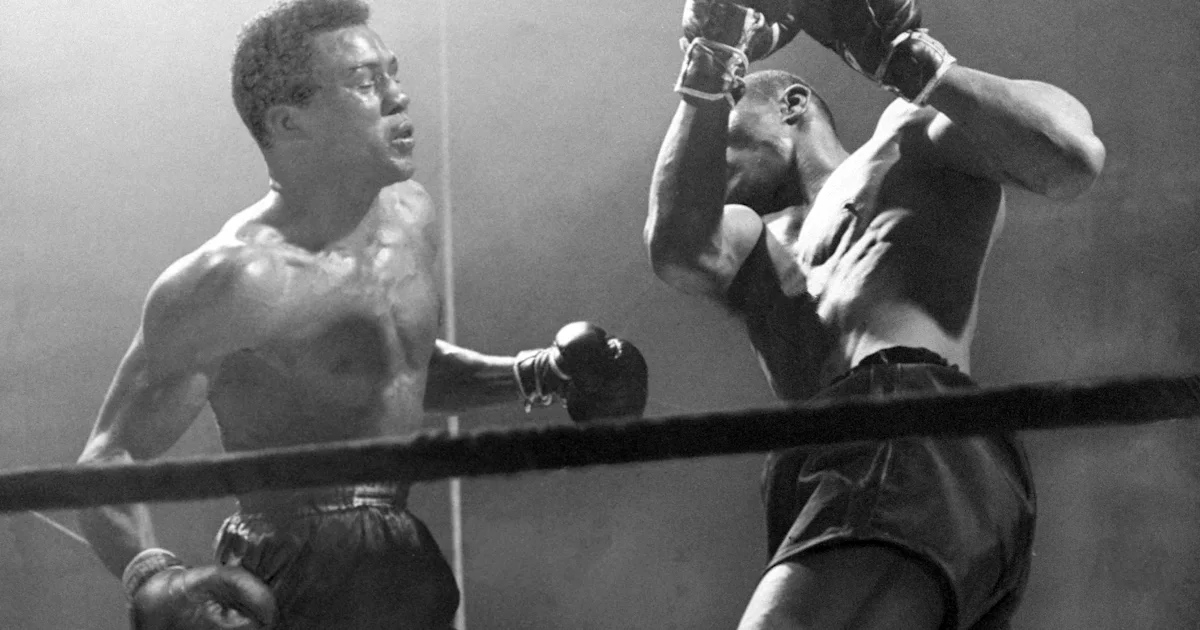
July 12, 1948: Beau Jack (R) throws a looping right as lightweight champion Ike Williams rocks back with the punch.
(Bettmann via Getty Images)
If you judge them solely on their records against one another, Williams was superior, having gone 4-1-1, while Montgomery was second at 3-3, and Jack was 2-5-1.
Advertisement
However, far more important than their records was their willingness to repeatedly face each other despite knowing they would have to go through hell to achieve victory — and knowing that their brains and bodies would pay an exacting price.
Yet they consistently embraced that challenge anyway. And it was because of that shared desire to face the best competition, along with their tremendous skills, that allowed them to build Hall of Fame careers and forge unforgettable legacies.
That collective attitude is one that Garcia, Davis, Lopez and Haney need to start emulating immediately, and specifically toward each other, if they have any hope of creating lasting legacies like the heroes of lightweight’s past.