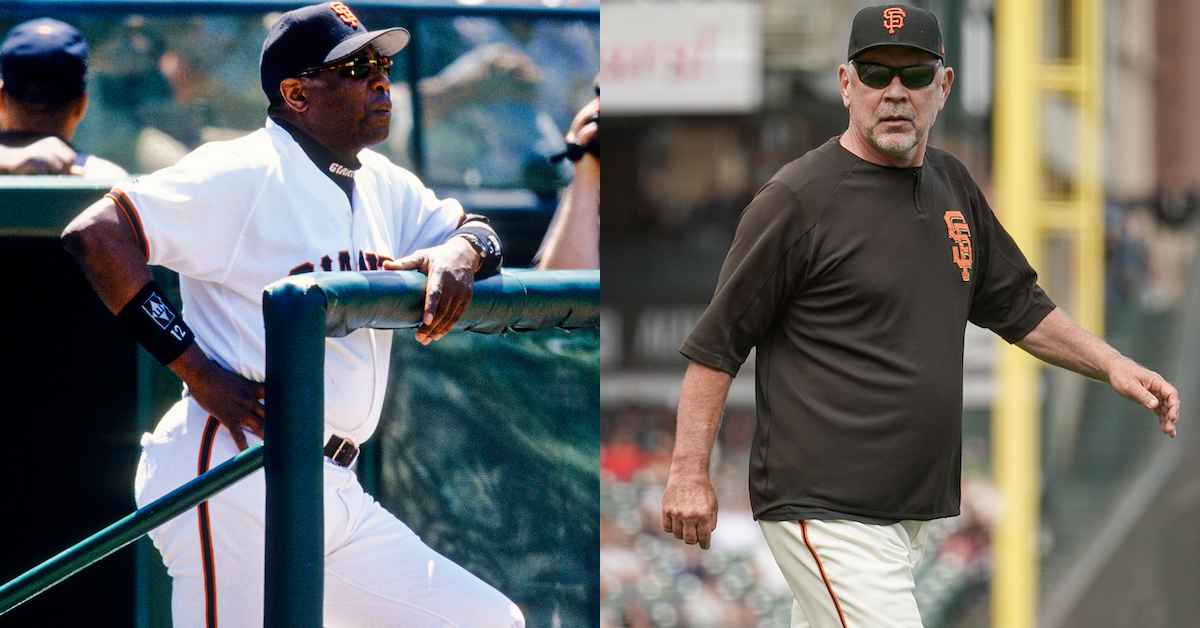
Induction Day in Cooperstown next summer could be a Giant affair, or at least have a very Bay Area-oriented theme. On Monday, the Hall of Fame announced its slate of eight candidates for the 2027 Contemporary Baseball Managers/Umpires/Executives ballot, dedicated to non-player candidates who made their greatest impact from 1980 to the present. The group is headlined by a pair of first-time eligible managers with ties to San Francisco, namely Dusty Baker and Bruce Bochy, plus the general manager who oversaw their most successful seasons in the Giants dugout, Brian Sabean. Also on the ballot is another Bay Area general manager, Sandy Alderson, who built an A’s team that won three straight pennants and a World Series. On December 6 we’ll find out if any of them will be inducted next July 25, very possibly alongside former Giants superstar (and current president of baseball operations) Buster Posey, the top newcomer on the BBWAA ballot, which will be released on November 16.
There’s plenty more to digest regarding this ballot, which also includes two other World Series-winning managers in Joe Maddon and Lou Piniella, maverick owner Ted Turner, and pioneering executive Bill White. Piniella and White are the top two returnees from the 2024 slate that elected Jim Leyland. Piniella has missed by one vote in each of his past two appearances counting the 2019 Today’s Game Era Committee ballot from the previous four-committee format. White (who also played for the Giants, though it’s each candidate’s post-playing career that’s the focus here) missed by two votes on the 2024 ballot but was the recipient of this year’s Buck O’Neil Award, given once every three years to “an individual whose extraordinary efforts enhanced baseball’s positive impact on society, broadened the game’s appeal, and whose character, integrity and dignity are comparable to the qualities exhibited by O’Neil.” Of the eight candidates, Turner is the only one who is deceased; he died on May 6 at age 87.
2027 Contemporary Baseball Era Committee Managers/Umpires/Executives Ballot
| Candidate | Born-Died | Category | Most Recent Ballot Appearance |
|---|---|---|---|
| Dusty Baker | 1949–Living | Manager | None (1st time) |
| Bruce Bochy | 1955–Living | Manager | None (1st time) |
| Joe Maddon | 1954–Living | Manager | None (1st time) |
| Lou Piniella | 1943–Living | Manager | 2024 Contemporary Mgr/Exec/Umps (68.8%) |
| Sandy Alderson | 1947–Living | Executive | None (1st time) |
| Brian Sabean | 1956–Living | Executive | None (1st time) |
| Ted Turner | 1938–2026 | Executive | None (1st time) |
| Bill White | 1934–Living | Executive | 2024 Contemporary Mgr/Exec/Umps (62.5%) |
I’ll have more to say about each of those candidates below and in the coming weeks, but first, some nuts and bolts. The eight candidates will be voted on by a 16-member committee of Hall of Famers, executives, and writer/historians that was appointed by the Hall’s board of directors. They will meet and discuss the candidates in person in San Diego on December 6, where the Winter Meetings would be held if not for the impending lockout by the owners. Each voter can include up to three candidates on his or her ballot (down from four in the previous 10-candidate format, which ran through the aforementioned 2022 ballots). Election to the Hall requires 75%, meaning votes from 12 of the 16 panelists. The results of the voting will be announced live on MLB Network’s MLB Tonight at 8:00 p.m. ET, and any candidate elected will be inducted into the Hall next July 25 in Cooperstown along with anyone elected from the upcoming BBWAA ballot.
This ballot was assembled by a BBWAA-appointed, 11-member Historical Overview Committee that is separate from the one that votes. Its members include: Adrian Burgos (University of Illinois); Bob Elliott (Canadian Baseball Network); Steve Hirdt (historian); La Velle Neal (Minneapolis Star Tribune); David O’Brien (formerly The Athletic); Jose de Jesus Ortiz (Our Esquina Media); Jack O’Connell (BBWAA); Jim Reeves (formerly Fort Worth Star-Telegram); Glenn Schwarz (formerly San Francisco Chronicle); Susan Slusser (San Francisco Chronicle); and Mark Whicker (formerly Southern California News Group).
To be eligible for inclusion, managers and umpires need to have compiled 10 or more major league seasons and to have been retired for at least five years, though candidates 65 years or older are eligible six months following retirement. Executives need to have been retired for at least five years, though active executives 70 years or older are eligible “regardless of the position they hold in an organization and regardless of whether their body of work has been completed,” according to the Hall. By virtue of a new rule established by the Hall in 2025, candidates who do not receive at least five votes will not be considered for inclusion on the next ballot of that cycle, and any candidate to whom that happens twice will be permanently removed from consideration. While the rule is not retroactive, none of the five candidates from the 2024 ballot who fell short of that threshold (managers Cito Gaston and Davey Johnson, executive Hank Peters, and umpires Ed Montague and Joe West) has been included this time around.
With that out of the way… folks, this is an absolutely stacked ballot when it comes to the strength of the candidates. It’s probably the strongest slate since the 2022 Early Baseball Era Committee ballot that re-opened the doors to candidates from the Negro Leagues and pre-Negro Leagues Black baseball for the first time in 16 years. It was from that 10-man ballot that O’Neil and pioneer Bud Fowler were elected, while player/manager Vic Harris and pitcher John Donaldson fell two and four votes short, respectively, with other worthy Negro Leagues and pre-Negro Leagues Black baseball candidates and pre-World War II white candidates all overshadowed. The 2022 Golden Days ballot, a separate 10-man slate voted on the same day by a different committee, produced four honorees, namely Gil Hodges, Jim Kaat, Minnie Miñoso, and Tony Oliva, with Dick Allen missing by one vote; it was a very strong ballot as well, though of that group I favored only Allen and Miñoso plus Ken Boyer and Danny Murtaugh, neither of whom received more than three votes.
Paradoxically, the strength of this ballot may actually work against the candidates. In April 2022, the Hall reconfigured the Era Committee system from a staggered four-year cycle to a triennial one; at the same time, it reduced the number of candidates in an individual year from 10 to eight and the number of slots on each voter’s ballot from four to three. What had been a maximum of 64 votes spread across 10 candidates (an average of 6.4 per candidate) became a maximum of 48 spread across eight candidates (six per candidate). That doesn’t seem like much of a change, but the math becomes a problem, as Dan Szymborski helped me illustrate, building on a 2014 discussion between Joe Posnanski and Tom Tango and using a Monte Carlo simulation, a model along the lines of what we use to calculate our Playoff Odds.
You Aren’t a FanGraphs Member
It looks like you aren’t yet a FanGraphs Member (or aren’t logged in). We aren’t mad, just disappointed.
We get it. You want to read this article. But before we let you get back to it, we’d like to point out a few of the good reasons why you should become a Member.
1. Ad Free viewing! We won’t bug you with this ad, or any other.
2. Unlimited articles! Non-Members only get to read 10 free articles a month. Members never get cut off.
3. Dark mode and Classic mode!
4. Custom player page dashboards! Choose the player cards you want, in the order you want them.
5. One-click data exports! Export our projections and leaderboards for your personal projects.
6. Remove the photos on the home page! (Honestly, this doesn’t sound so great to us, but some people wanted it, and we like to give our Members what they want.)
7. Even more Steamer projections! We have handedness, percentile, and context neutral projections available for Members only.
8. Get FanGraphs Walk-Off, a customized year end review! Find out exactly how you used FanGraphs this year, and how that compares to other Members. Don’t be a victim of FOMO.
9. A weekly mailbag column, exclusively for Members.
10. Help support FanGraphs and our entire staff! Our Members provide us with critical resources to improve the site and deliver new features!
We hope you’ll consider a Membership today, for yourself or as a gift! And we realize this has been an awfully long sales pitch, so we’ve also removed all the other ads in this article. We didn’t want to overdo it.
In case you didn’t read all that, here’s the short version. Membership includes:
✓Ad-free browsing
✓Unlimited FanGraphs & RotoGraphs articles
✓Historical & platoon projections
✓Leaderboard & player-page stat heatmaps
✓One-click data exports
✓Customizable player-page dashboards
✓Dark & Classic site modes
✓Weekly Members-only mailbag
✓FanGraphs Walk-Off, your year in review
✓Optional homepage photo removal
✓Gift articles to non-Members
✓Full postseason coverage
Suppose you have a ballot where all 10 candidates are equal. You can’t figure out a way to separate any of them from the pack, and so you decide to choose four at random to vote for and hope for the best. Obviously, this is a hypothetical situation, but there’s a point to be made with this model. As Tango explained to Posnanski, if you have such a ballot where all 10 candidates have an equal chance (40%) of being named on a four-slot ballot, the yield is an average of 0.049 inductees per year, and the committee elects no one in 95.2% of the simulations. If you’re faced with the same dilemma regarding a ballot of eight candidates, with each candidate having a 37.5% chance of being named on a three-slot ballot, the yield falls to 0.021 inductees per year; that’s a drop from one candidate elected every 20 years to one every 48 years, with nobody elected 97.7% of the time. If you have a ballot where one half of the candidates are clearly better than the other half — say, the top four or five have a 70% chance of being named on a ballot with the bottom half dividing the remaining scraps — the yield falls from 2.25 inductees per year on the 10-person ballot to 1.8 per year on the eight-person ballot, with the odds of a shutout increasing from 5% to 9.2%.
These models oversimplify things, but the take-home point is that with fewer candidates to easily dismiss, the harder it becomes for a single candidate to get the supermajority necessary for election, to say nothing of multiple candidates getting to 75%. What we’ve seen so far since the format change is ballots where it’s not hard to identify some candidates as ballast, those who have been up for election several times before but have never or rarely gotten close and are likely to be bypassed. Even then, three of the four elections under the new format have produced just a single honoree:
Recent Era Committee Elections
Yellow = elected
When just one candidate gets in per year via this process, it creates a logjam for future ballots. Even for those who feel strongly that the 10 or 15 chances that post-integration players have received from the writers are ample, it should be clear that the Negro Leagues candidates haven’t received a fair shake in light of the explosion of research that has emerged in the past couple of decades (including the overdue recognition that the top Negro Leagues should be considered as major leagues). What’s more, this is the only route of entry for the non-players of the Contemporary Era, and new candidates arise with each iteration of the triennial cycle. A well-supported returning candidate like Piniella can get lost in the shuffle the next time around, and that’s before considering the troublesome two-strikes-and-you’re-out rule.
With so many candidates, particularly first-timers, worthy of a closer look, the real name of the game for a voter is figuring out which ones to prioritize, and that’s what I’ll do in this space in the coming weeks. I don’t have an actual vote — I’ve never served on an Era Committee — but I go through this exercise as though I do, because I know readers and voters find it useful.
Sandy Alderson
When he joined the A’s as their general counsel in 1981, Alderson had no baseball background, but two years later he became their general manager, and absorbed the lessons of early sabermetricians Bill James and Eric Walker. Applying those principles, he built the A’s into a dynasty that won four AL West titles, three pennants and one World Series from 1988-92, then oversaw the rebuilding effort that eventually handed the reins to Billy Beane. After leaving the A’s in late 1998, Alderson worked in the commissioner’s office as Major League Baseball’s executive vice president for baseball operations; as the CEO of the Padres, overseeing their back-to-back NL West titles in 2005 and ’06; and as the general manager of the Mets from 2010–18, most notably building their pennant-winning 2015 team.
Dusty Baker
A two-time All-Star during his 19-year playing career, Baker joined the Giants as a coach, and in 1993 — two weeks after Barry Bonds signed as a free agent — became just the seventh Black manager hired to lead an AL or NL team. Baker’s 10-year run managing the Giants included three playoff appearances, highlighted by the 2002 NL pennant, which came the year after Bonds broke the single-season home run record. Baker made additional stops with the Cubs (2003–06), Reds (2008–13), Nationals (2016–17), and Astros (2020-23), leading each franchise to at least one postseason appearance; he’s the only manager to take five teams to the playoffs, a singular distinction but also a bit of a sore spot with the man. Early postseason failures highlighted his tactical foibles, but he aged very well. The Astros hired him in the wake of their sign-stealing scandal, and he led them to back-to-back World Series appearances in 2021–22, finally winning it all in the latter season, his 25th as manager. At 73, he was the oldest manager to win a World Series, and just the third Black manager after Gaston and Dave Roberts. His 2,183 wins ranks eighth all-time.
Bruce Bochy
Once Bochy’s nine-year playing career as a backup catcher ended, he worked his way into the Padres’ dugout, first as a coach and then as manager. While he endured some lean years during his 12-season run (1995–2006), he piloted the Padres to four division titles and their 1998 pennant before moving on to the Giants, whom he managed for 13 seasons (2007–19), chalking up two division titles, two Wild Card berths, and championships in 2010, ’12, and ’14. After stepping down, he resurfaced with the Rangers and immediately led them to their first championship in 2023, making him just the sixth manager to win four World Series. His total of 2,252 wins is sixth all-time, and his total of games managed is fourth.
Joe Maddon
After 31 years in the Angels’ organization as a player, minor league manager, and major league coach — most notably as Mike Scioscia’s bench coach from 2000–05 — Maddon took over the Tampa Bay Devil Rays in 2006 and helped guide them towards respectability under a cutting-edge front office. The young, newly-exorcised Rays won the division title and AL pennant in 2008 and became perennial contenders on Maddon’s watch, making three more playoff appearances during his nine-year tenure before he departed to pilot the Cubs. He guided Chicago to the playoffs four times in five seasons, most notably leading the Cubs to their first championship in 108 years in 2016.
Lou Piniella
After an 18-year major league career that spanned from 1964-84 and included World Series rings with the 1977 and ’78 Yankees, Piniella spent 21 full seasons and parts of two others managing the Yankees (1986-87, ’88), Reds (1990-92), Mariners (1993-2002), Devil Rays (2003-05), and Cubs (2007-10). He led the Reds to a 1990 championship but could not get any of his other teams — including the 116-win 2001 Mariners — back to the World Series despite five additional division titles and a Wild Card appearance. He’s 17th all-time with 1,835 wins.
Brian Sabean
As a scout, director of scouting, and vice president of player development during his 1985-92 run with the Yankees, Sabean had a hand in the acquisition and development of the “Core Four” of their Joe Torre-led dynasty, namely Hall of Famers Derek Jeter and Mariano Rivera, as well as Andy Pettitte and Jorge Posada. He joined the Giants in January 1993, became their GM in ’96, and helped turn the franchise around, building the aforementioned four pennant winners piloted by Baker and Bochy as well as three other teams that won division titles.
Ted Turner
An impulsive, hands-on owner during his early years owning the Braves — so hands-on that he had even managed the team for one night, only to be prohibited from doing so again — Turner found controversy at every turn. In his first decade of ownership, the Braves had only sporadic success, though Turner turned them into a household concern via his growing cable television empire. Once he re-hired Bobby Cox, whom he’d dismissed in 1981, as general manager after the ’85 season, he learned to stay out of the way, and set in motion the building of a dynasty that would win four pennants and a championship from 1991–96, then continue to dominate the NL East for nearly another decade. Turner relinquished control after selling the team to Time Warner in 1996, but he had proven himself a visionary when it came to cable television.
Bill White
After a 13-year career (1956-69) that included five All-Star appearances and a championship with the Cardinals, White spent 18 years as a broadcaster for the Yankees and for national networks; he was the first regular Black play-by-play announcer for a major league team. His pioneering continued when he was elected to become the National League president in 1989, making him the first high-ranking Black executive in any major sport. He served in that post through 1994. As noted above, the Hall honored him with its Buck O’Neil Award earlier this year, but receiving that award doesn’t preclude election to the Hall — it didn’t for O’Neil, though sadly he didn’t live to see himself elected.
With a ballot that full of compelling candidates, I’m not ready to hazard a guess as to how this will play out on December 6, let alone how I’d vote if I had a ballot. I do expect several of these men to remain worthy of consideration the next time this slate comes up for discussion, because it’ll be mathematically impossible to elect all of the worthy ones in a single cycle.