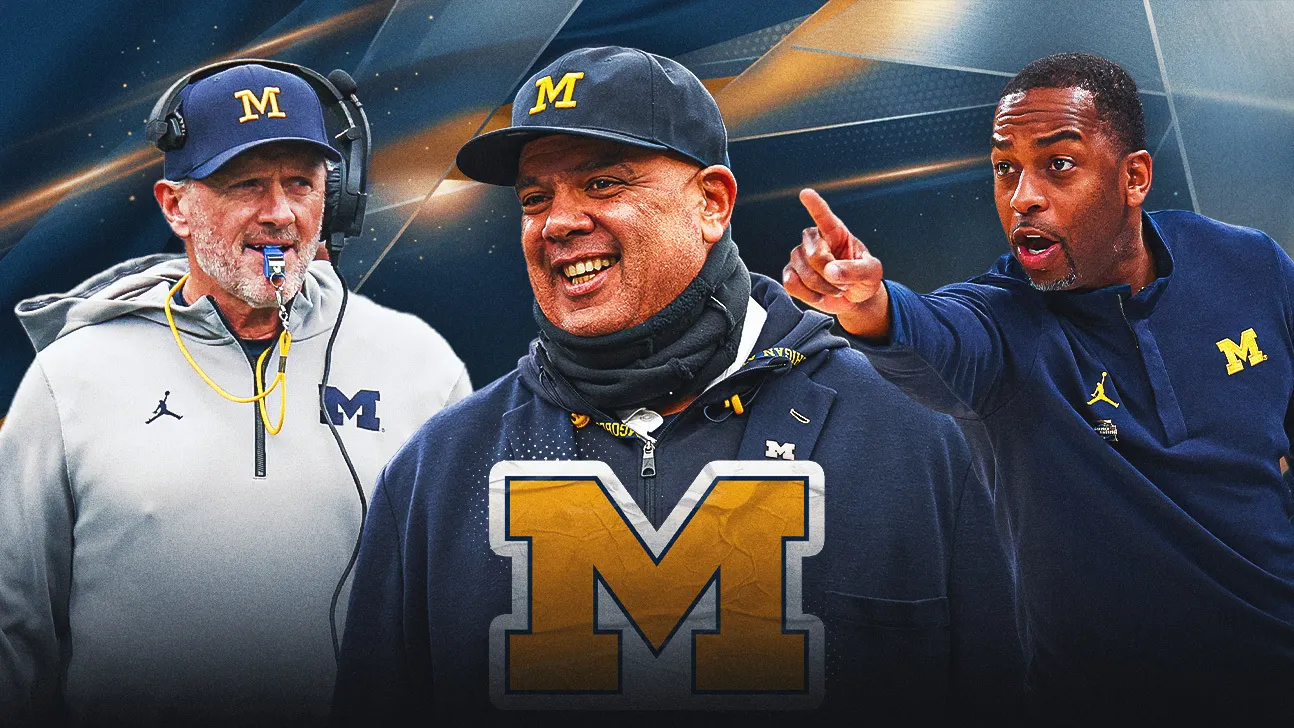
With each passing week and each additional layer of scrutiny surrounding Michigan athletic director Warde Manuel, how differently could this saga have unfolded if not for the tragic news involving Kent Syverud, who was slated to become the university’s next president?
A few weeks after Manuel hired Kyle Whittingham as the Wolverines’ next football coach in late December, the Board of Regents announced that Syverud would become the 16th president at Michigan. Syverud, who was previously the chancellor and president at Syracuse University, was scheduled to take over for interim president Domenico Grasso on July 1 of this year.
But in mid-April, just a few days after Michigan’s men’s basketball team won the national championship, Syverud announced that he had been diagnosed with brain cancer. He stepped down from his presidency before it even began. Grasso was eventually elevated to the full-time position, though not quite in a permanent capacity: The Board of Regents said that the search for a 17th president would begin anew.
Domenico Grasso, Warde Manuel and Dusty May during the men’s basketball national championship celebration in April. (Photo by Aaron J. Thornton/Getty Images)
Correctly or not, it was widely assumed that one of Syverud’s main objectives after assuming his new position would be to change leadership within Michigan’s athletics department. For years, Manuel’s tenure with the Wolverines had been peppered with hiring missteps, NCAA violations and embarrassing conduct from his employees. None more so than former football coach Sherrone Moore, whom Manuel fired last December after the department found “credible evidence” of an inappropriate relationship with a subordinate.
That Manuel interspersed each blemish with four national championships — including one each for football (2023) and men’s basketball (2026), the most lucrative and highest-visibility sports — was enough for him to keep his job longer than most people expected. But all of that ended on July 20, when Michigan announced that Manuel will be stepping down from his position at the end of the calendar year.
So what does this mean? Here’s a look at what’s next for Michigan.
What Does Warde Manuel’s Departure Mean For Michigan Athletics?
In the same way that Michigan’s decision to hire Whittingham represented a noteworthy departure from those who were connected to the pockmarked tenure of alum Jim Harbaugh, this most recent divorce between the Wolverines and Manuel affords the institution an opportunity to do the same atop its athletics department.
Kyle Whittingham after the Michigan 2026 spring football game. (Photo by Scott W. Grau/Icon Sportswire via Getty Images)
A native of New Orleans, where he was an All-American high school football player, Manuel matriculated at Michigan and played under legendary head coach Bo Schembechler in the late 1980s, including a spell as Harbaugh’s teammate. And though his gridiron contributions were prematurely halted by a neck injury, Manuel still won multiple varsity letters in multiple sports for the Wolverines, shifting over to the track and field team before the end of his undergraduate career. He went on to earn three degrees from Michigan between 1990 and 2005: a bachelor of general studies, a master’s in social work and an MBA.
In other words, Manuel falls neatly within the framework of the proverbial “Michigan Man” persona that was popularized by Schembechler, who manned the sidelines for two decades and eventually became the school’s athletics director. That pedigree alone helps explain why Manuel, now 58, was hired by the Wolverines in 2016. Now, it’s also one of the reasons why so many fans wanted him removed.
A steady stream of shameful institutional missteps and public relations nightmares during Manuel’s tenure have dulled the sheen so often associated with the proud “Michigan Man” archetype.
Most notably, the stomach-turning sexual abuse scandal involving Dr. Robert Anderson, now deceased, and the university officials who overlooked — or flat-out ignored — years of accusations surrounding the physician’s suspected misconduct during a 50-year career. In 2022, Michigan eventually agreed to a $450 million settlement with more than 1,000 of Anderson’s victims. The jaw-dropping revelation that Schembechler, who coached at Michigan from 1969-89, was among those authority figures shielding in real time began to erode the outsized legacy he and his disciples left behind.
Warde Manuel in 2024. (Photo by Aaron J. Thornton/Getty Images)
Though Moore never played for Michigan prior to joining the Wolverines’ coaching staff in 2018, the decision to fire him amid another off-field controversy in December was seen as a necessary step if the program wanted to finally distance itself from anyone linked to Harbaugh, who himself is inextricably linked to Schembechler.
Each victory Harbaugh amassed during an unprecedented run over his final three seasons — a period capped, of course, by winning the national championship in 2023 — seemed to be met with another round of eyebrow-raising headlines:
- Recruiting violations from the COVID-19 dead period
- Cyber hacking of intimate photos and videos by offensive coordinator Matt Weiss
- A self-imposed three-game suspension for Harbaugh during Michigan’s undefeated season
- The sign-stealing saga devised and perpetrated by analyst Connor Stalions
There were also many others.
Jim Harbaugh in 2024. (Photo by Maddie Meyer/Getty Images)
In fact, firing Moore meant that Michigan could finally move on from whatever remnants of Harbaugh’s highly successful, highly controversial tenure he had left — the good, the bad, the outrageous, and all of it. The Wolverines signaled that they were moving away from a seminal figure in the program’s history, a true corn and blue pick, but someone who also muddied the waters of the NCAA’s continued rules and long-term releases to the increasingly tainted Schembechler era.
Parting ways with Manuel, whose time Michigan can be associated with all of those things, offers Michigan another chance to start over, to finally tighten the button on the top level of the athletic hierarchy. His replacement may come from outside the Wolverine family.
How Will Manuel Retiring Affect Michigan Football?
As Michigan’s day-to-day athletic director, Manuel prefers to work beyond the arc whenever possible. He was much less free-spirited than some of his colleagues around the country — popular athletic directors like Pete Bevacqua at Notre Dame or Ross Bjork at Ohio State, for example — and reserved many of his regular hourly comments for a friendly local radio station in Ann Arbor.
Kyle Whittingham talks to his team following the Michigan 2026 spring game. (Photo by Babylon Crawford/Getty Images for ONIT)
The only real exceptions were when Manuel puffed out his chest to reporters in the final moments of championship coverage for the football and men’s basketball programs, which seemed to relish the opportunity.
A connection can be drawn between Manuel’s relative advantage in tackling the mainstream, the primary role attributed to modern ADs, and the most frequent criticism surrounding how he approached the job.
Critics, both publicly and privately, have questioned Manuel’s creativity and aggressiveness with things like general fund-raising efforts, implementing NIL plans and negotiating contracts with Michigan coaches for various sports.
It wasn’t until the Wolverines drew five-star QB Bryce Underwood to his senior season of high school that Michigan used a fully modernized player to acquire, and almost three years later the NIL was introduced on July 1, 2021. Even then, sources familiar with the inner workings of Underwood’s recruitment never included Manuel when asked about the figures in the majors.
Jim Harbaugh and Warde Manuel in 2016. (Photo by Adam Ruff/Icon Sportswire via Getty Images)
All that said, the Wolverines could benefit significantly from choosing a leader more focused on enhancing Michigan’s future than simply honoring or preserving its illustrious past. This is important considering Whittingham, the new football coach, will turn 67 later this year and has never been coached in a power conference. He built a decorated Hall-of-Fame career while serving as the head coach at Utah for more than two decades.
Now, as college football continues to evolve on what I feel is a daily basis, strong leadership and leadership will be needed from the top department to properly serve Michigan’s great institutional interests.
What about Michigan Men’s Basketball?
At the moment, it became clear that Manuel’s unequal tenure might not last beyond the university’s board of regents, meeting in Traverse City, Michigan last Thursday.
The day leading up to that regularly scheduled gathering was filled with speculation and scuttlebutt surrounding the independent investigative firm Jenner & Block, whose bill with the school had already risen to nearly $12 million and from which the business plan was commissioned.
The Michigan Wolverines were celebrating winning the 2026 NCAA Men’s National Championship. (Photo by Mitchell Layton/Getty Images)
The Wall Street Journal said the investigation had already found evidence that Michigan had received “repeated reports of”. [Sherrone] Moore’s behavior,” which pertained to his abusive relationship with Paige Shiver, his former executive assistant.
The Board of Regents came to the Lord’s Supper and left without any discussion about Manuel’s future. Neither Manuel nor the question was discussed by Jenner & Block. Business, it seemed, would remain at least longer than usual. That’s exactly how Manuel would work.
Six days before the Board of Regents meeting, Manuel announced that he would drop the “interim” tag attached to men’s coach Mike Boynton Jr. After the parties agreed on a two-year contract. Boynton, 44, served as an assistant and defensive coordinator for the Wolverines under head coach Dusty May for the last two seasons, leading the program to its second national championship in school history. He has worked tirelessly as the core of Michigan’s Rosary ever since May decided to leave for the NBA job last month.
“Mike is a veteran assistant with extensive head coaching experience and a clear understanding of the standard we expect at Michigan,” Manuel said in a press release. “He has been an invaluable member of our team over the past two years, bringing stability, leadership and perspective to our big-time success.”
Dusty May and Mike Boynton Jr. during the practice day ahead of the first round of the 2016 NCAA men’s basketball tournament. (Photo by Ishika Samant / Getty Images)
Within a week, although members of the anti-Manuel contact group were given yet another reason to roll their eyes at the business. Boynton’s new two-year contract, which will pay him $3.6 million for the 2026-27 season, includes a series of unique performance benchmarks to qualify. to reach The deal is in the second year, according to records requested by MLive and an article published Thursday.
“The goal of the playoffs cannot have I or II violations,” writes beat reporter Andrea Kahn, “Boynton cannot violate any policies or rules, and all players must be academically eligible. The Wolverines must also reach the final four or at least two of the following: win at least 24 regular season games (out of 31), finish in the top four in the Big Ten, win the Big Ten tournament, win or win.
All of these skills make sense for a program that returns several key players from a national championship squad and also received another star-studded transfer class to Ann Arbor, not to mention five-star freshman Brandon McCoy Jr., the gem of Michigan’s high school recruiting class.
But with such solid credentials comes a lot of added pressure for a head coach who already has immense shoes to fill.