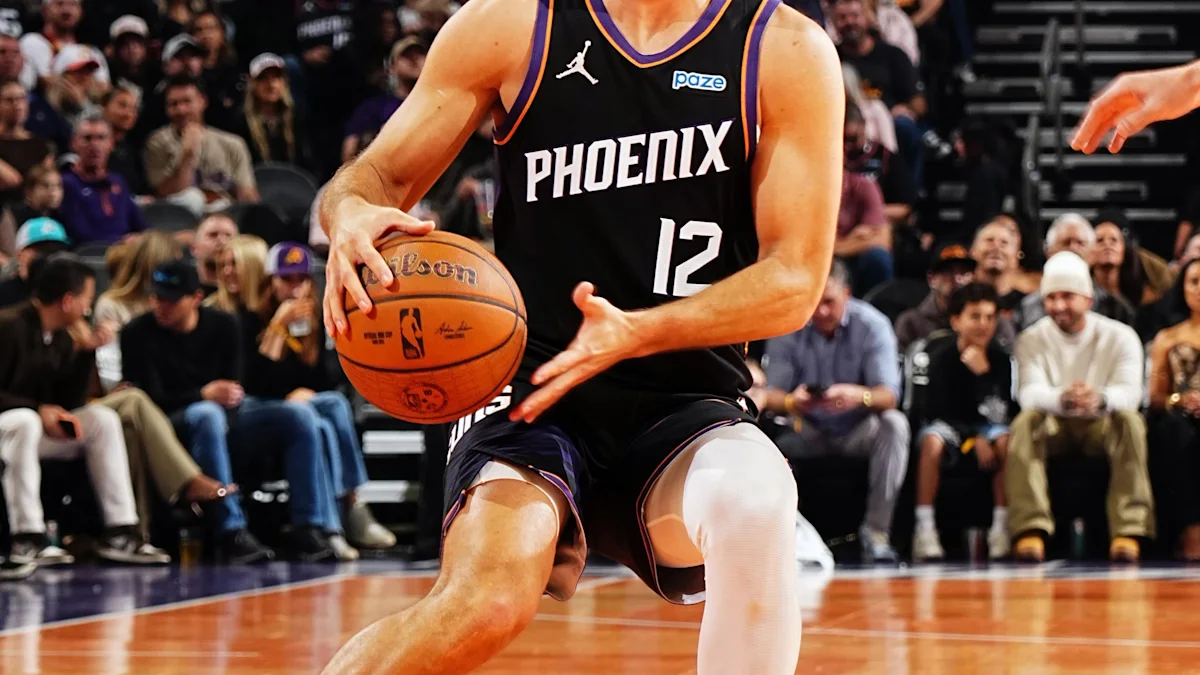
The season is young for the Phoenix Suns, and every game offers another chance to learn more about this team and whether it can execute its vision in a way that translates to winning. Thus far, it’s been rough. Phoenix is off to a 1-3 start, and if you take a look at the defensive rating, it certainly feels like Halloween. Because those numbers are downright spooky. Last in defensive rating at 125.8, last in opposing three-point percentage at 43.9%, last in opposing second-chance points at 22.3.
You don’t want to make rash decisions based on individual performances during the infancy of a season, but at some point you need to recognize that whatever this version of the Suns is isn’t working. At least not yet. Should patience be exercised? Perhaps, and we begrudgingly know it will. Until an internal threshold relative to either games or minutes has been crossed, this experiment in futility marches forward, with each night serving as a quiz to examine.
Advertisement
What did Friday’s night pop quiz teach us? It reinforces something we’ve known since we first started watching, playing, and consuming this glorious sport: teams function better when roles are clearly defined. “Positionless” basketball is a lazy term for those who support teams that do not possess defined roles. For teams with duplicative archetypes in the same starting lineup. “It’s gonna make sense,” one will say of the starting five. “Why?” a curious and befuddled onlooker will question. “Because the NBA is now ‘positionless'”.
I’m guilty. I’ve bought into the cheap trick and five-dollar fantasy that positionless basketball could equate to success. I purchased some stock in the belief that a Booker/Beal backcourt could be productive, and it’s why I’ve been cautious about the Booker/Green backcourt since its inception. Fool me once, shame on me n’ such. Sure, you can have a pair of combo guards in the backcourt, but they still need to have defined roles, defined areas of space in which they operate, and one better be pretty damn good at being the primary ball handler. Some call those roles “positions”.
Positionless basketball is something that has become a product of the AAU circuit, where young players are encouraged to pad their statistics because, ultimately, those numbers help them get noticed and create opportunities to make it big one day. With the NIL era upon us, getting noticed has become even more financially important. Somewhere along the way, traditional point guard play, facilitation, and distribution have become less of a priority. Those are the things that make everyone around you better, even if they don’t always show up in the box score.
Within the concept of positionless basketball, there still needs to be an understanding of roles and, more importantly, who is actually capable of executing them. What we witnessed Friday night, and quite frankly what we’ve seen throughout a season and a half, is another reminder that this offense simply functions better when Collin Gillespie is involved. He’s not a traditional point guard, but he excels in that role. That’s what the Suns need right now.
Advertisement
Why? Because Jalen Green was having an off night, something that has unfortunately plagued him throughout his career. Consistently, he’s been inconsistent. 20 points on 8-of-13 shooting against OKC, 2 points on 1-of-6 shooting against Denver. When you look at his career scoring trend, you see dots scattered about like duck shot on an outhouse.
I can’t blame the young lad. This team wants Jalen Green to be a facilitator, to essentially play point guard. And when you’re forced into an unfamiliar role, it takes time to adjust. Unfortunately, point guard is one of the most difficult positions to play in the NBA. It requires selflessness, court awareness, and the ability to process information at an incredibly high speed.
You can almost feel Jalen thinking out there early this season. He’s trying to read the defense, make the right decision, and execute what’s being asked of him. And the best flashes we’ve seen? They come when he stops thinking and starts reacting. That’s his superpower. His instincts, explosiveness, and ability to attack without hesitation are what make him dangerous.
Advertisement
It reminds me of Ryan Dunn, who’s being asked to become a true 3-and-D player despite that not necessarily being what his natural skill set lends itself to. Once again, the Suns find themselves asking a player to become something he isn’t, rather than maximizing what he already does well. And in the process, they’re diminishing the very qualities that make him valuable.
Green is better off the ball, operating as a piece of the offense rather than being the driving force behind it. Therein lies the roster construction conundrum we’ve been staring at for two seasons: 57% of your cap is tied up in duplicative players. Because the same could be said about Devin Booker. He excels when his role is not the offensive facilitating fulcrum. That, my fellow Suns’ citizens, is criticism I’ll save for another day…
We heard throughout the offseason that Green had spent time working with Steve Nash, with the goal of improving his ability to read opposing defenses and make quicker decisions. Early this season, it’s apparent that his processing is taking a split second too long. His assist percentage is 14.1% (33rd percentile), his assist-to-turnover ratio is 1.3 (14th percentile), and his assist points created is 6.0 per game (25th percentile).
In the NBA, where you’re facing elite athleticism and basketball IQ night after night, a split second can make all the difference in the trajectory of a career. Unfortunately, when you’re looking for someone to make high basketball IQ plays with split-second decision-making, Green typically isn’t the first player who comes to mind.
Advertisement
It’s a reminder that Jalen Green entered the NBA following his time with the developmental G League Ignite as a player whose greatest asset was his elite athleticism. He jumped off the high school screen with his explosiveness, his ability to finish around the basket, his shooting potential, and his impressive physical tools. He possessed the kind of raw talent that makes scouts salivate and front offices dream about what a player could eventually become.
His career thus far has been relatively average, with much of his scoring production coming through volume rather than efficiency. The physical gifts are undeniable. The challenge has been turning those gifts into consistently productive basketball.
Collin Gillespie took an entirely different path. He went from fighting for an opportunity on a two-way contract to earning a fully guaranteed deal and eventually a contract extension. And what keeps him on the floor? It certainly isn’t elite athleticism. It’s his defensive effort, his ability to read the floor offensively, his understanding of how to operate within a system, and his efficiency, particularly from beyond the arc.
Advertisement
So why am I bringing up the career paths of these two players? Because they represent two fundamentally different approaches to succeeding in the NBA. Green entered the league relying on extraordinary athleticism and the freedom to operate outside traditional positional responsibilities. Gillespie has built his career by understanding those responsibilities, embracing them, and executing within the structure around him. One was given opportunities because of what his physical gifts suggested he could become. The other earned his opportunities by consistently demonstrating that he understood exactly what his team needed him to be.
Collin Gillespie is more comfortable handling the ball, navigating his way through defenses, creating mismatches, and reading what the opposition is doing as those opportunities develop. Through four games this season, his assist percentage is 18.1% (38th percentile), his assist-to-turnover ratio is 3.3 (36th percentile), and his assist points created is 14.5 per game (64th percentile). Not gaudy numbers, but certainly improvements over what Green has provided in this small sample size to start the 2026-27 season.
Friday night was a reminder of this. Against Denver, during his first six minutes on the floor, Green and the Suns were a -3. Gillespie entered, and over the next nine minutes, Phoenix was a +7. That trend continued throughout the game. The team was chunky when Green was on the floor, fluid when Gillespie was present.

When Green entered, the offense tended to sputter. This isn’t solely his fault. The entire starting five was having trouble producing, as apparent from the rotations showcased above. When he and Devin Booker shared the court, roles were not defined, and the team had a -19.8 net rating.

When Booker was off the court and Green was tasked with the “bring the ball up the court” duties, the ball became sticky. The offense was less fluid. He’d dribble for a while, attack the basket, get blocked, and that was the possession. No movement, no opportunity for anyone else to get involved.
Through four games, albeit with a small sample size, Green possesses a minus-28.3 net rating compared to Gillespie’s minus-2.3. And when you examine the on/off numbers, they speak for themselves.

The defensive side of the ball will always be the weaker part of this argument because Green has the opportunity to provide more defensively due to his size. For all the heart Gillespie has, he’ll never possess the physical tools to be an elite defender, yet he’s still third in the league with 3.0 steals per game.
Advertisement
When you look up and down the roster at the statistical output, particularly defensive rating, nobody on this team looks good. That’s what happens when you have the worst defense in the league. But there’s a significant difference between Jalen Green’s 133.3 defensive rating and Gillespie’s 120.7. So even on that end of the floor, Gillespie has been the better option.
I’ve hit you with a ton of advanced metrics and lineup data, but do we really need all of that? We know what our eyes are telling us, and at the end of the day, they’re telling us that there’s considerably more fluidity offensively and more intensity defensively when Gillespie is on the floor instead of Green.
This isn’t to suggest that the two players can’t coexist on the roster, because at this point in the season, they’re going to have to. The Suns will continue evaluating Green to determine whether he fits into what this team currently is and what it could eventually become. When you’re carrying a $36.3 million price tag, naturally, there’s going to be increased scrutiny surrounding your performance.
We need to see a larger sample size, right? But in reality, do we? Because we’re beginning to witness some of the same trends we saw last season with Green…

Remember the beginning of last year, when the Suns seemed to have a clear understanding of who they were? Green was injured for much of that stretch. When he returned, the team experienced some destabilization as it attempted to integrate him into the rotations and figure out how he fit.
Advertisement
What’s going to happen in the upcoming games? We might not know, but we saw a hint Friday night of what Jordan Ott is beginning to experiment with. Collin Gillespie closed the game while Jalen Green watched from the bench because Ott recognized that, within the confines of that particular matchup, it gave the Suns their best opportunity to win. How long until there’s a realization that, from an organizational standpoint, this might be the Suns’ best opportunity to win moving forward?
Not surprisingly, the team is standing with Green. “We’ve got a ton of confidence in JG,” Collin Gillespie said of his teammate following the loss to Denver. “We’re riding with JG 100 times out of 100.”
Moving Green to the bench is something I believe could benefit him. He’d be operating in a role much more conducive to his skill set, allowing him to focus on what he does best. But there’s also the potential for his ego to take a hit, and that’s the human element of this entire situation. It’s something we as fans have very little connectivity to when it comes to understanding the inner workings of the Phoenix Suns. There’s more to this than plugging and playing names into a roster. There are personalities involved, relationships to manage, and aspects of humility that need to be considered as well.
Advertisement
Again, we’ve now experienced this for 36 games if you go back to last season, and the results continue to be disjointed and disconnected on both ends of the floor. Green isn’t the sole reason for that, either. When Devin Booker scores three points in one game and then follows it up with another performance in which he doesn’t appear particularly aggressive, finishing with only 20 points, there are clearly greater issues at play. There’s one common concern running through all of it: your highest-paid players aren’t providing the effort and production you need from them consistently.
Maybe it’s too early to draw conclusions. My guess is that the franchise will give this another eight to ten games before seriously considering any drastic changes. Putting the human element aside for a moment, you eventually have to recognize who a player is, what he brings to the table, and whether his production matches the price you’re paying for it.
We’re only four games into the season, but Jalen Green is shooting 28.6% from beyond the arc, possesses an assist percentage of only 14.1%, and has a defensive rating that’s in the shitter. Those aren’t encouraging numbers for someone who’s supposed to be your starting “point guard”, especially when the offense continues to struggle with connectivity and the defense remains a significant concern. For context, Devin Booker isn’t exactly lighting things up defensively himself, carrying a defensive rating of 137.2.
At some point, the Suns have to decide whether they’re more committed to the idea of what Jalen Green could become or the reality of what Collin Gillespie already provides. Green can still be valuable, and finding a role that maximizes his strengths should remain a priority (although, at that price tag…yikes). But Phoenix needs someone who can organize the offense, make quick decisions, execute on the defensive end, and bring consistency to a lineup desperately searching for it. Gillespie has demonstrated that he can do those things. The question is how much longer Jordan Ott is willing to experiment before acknowledging what’s already working.