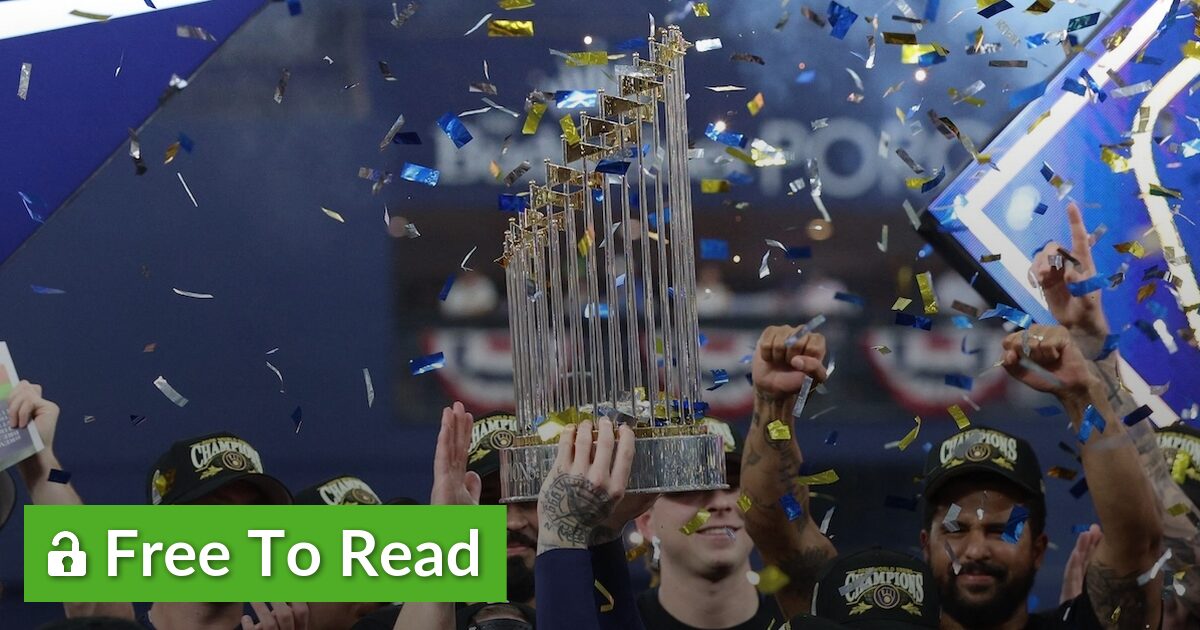
Fifty-seven years after their lone season as the Seattle Pilots, 56 after a used car salesman brought them to Milwaukee at the end of spring training, and 44 after they won their first pennant, the Milwaukee Brewers are world champions. After nearly completing a four-game sweep on Tuesday night before the Rays rallied in the 12th inning, they finished the job on Wednesday night with a 4-1 victory.
There’s plenty to be said about the individual performances of this year’s champions. William Contreras won World Series MVP honors by hitting .381/.435/.429, throwing out four would-be basestealers, and winning 10 out of 13 ABS challenges. Jackson Chourio gave Contreras a run for the money in the MVP race, tying a 98-year-old record held by Babe Ruth by collecting 10 hits over the first four games of the World Series, and leading all players with 11 hits and a .458 batting average. Cooper Pratt collected six straight hits in Games 4 and 5, batting .421/.455/.684 while leading all players in slugging percentage and RBI (seven). Aaron Ashby set a postseason reliever record with 18 consecutive scoreless innings, and allowed just one baserunner in 5.1 World Series innings while striking out nine. Likely National League Cy Young winner Jacob Misiorowski, seemingly low on gas during the first two rounds of the postseason, bookended the World Series with a pair of strong starts totaling 10.2 innings while allowing just one run. Speaking of bookends, Chourio, Contreras, and reliever Antonio Senzatela were all members of Team Venezuela’s World Baseball Classic-winning squad, joining Alex Bregman and Luke Gregerson of the 2017 Astros and Team USA as the only players to win both championships in the same calendar year.
Beyond all that, it’s worth placing the Brewers’ postseason run in some historical context. For starters, their eight straight wins — from Game 4 of the Division Series against the Padres through their four-game sweep of the two-time defending champion Dodgers in the League Championship Series to their first three wins over the Rays in the World Series — tied a single-season record held by the 2004 Red Sox, 2005 White Sox, 2014 Royals, and 2019 Nationals. (Such a record wouldn’t even have been possible before 1985, when the ALCS and NLCS expanded from a best-of-five series to a best of seven.) Additionally, the Brewers are the fifth team of the Wild Card Era (1995 onward) to lose two or fewer postseason games while winning it all. They very nearly became the third such team to do so with only one loss, but the baseball gods refused to cooperate with that version of this article.
Dating back to 1969, the dawn of division play, the multi-round playoff system, and the aforementioned Pilots — who joined the newly-founded American League West along with the expansion Kansas City Royals — the Brewers are the 13th championship winners to complete the postseason while losing no more than two games. They fell just short of becoming the second to sweep both the LCS and the World Series:
World Series Winners Since 1969 with Two or Fewer Postseason Losses
| Wild Card Era | Season | W | L | W-L% | Division Series | League Championship Series | World Series |
|---|---|---|---|---|---|---|---|
| Yankees | 1999 | 11 | 1 | .917 | 3-0 (Rangers) | 4-1 (Red Sox) | 4-0 (Braves) |
| White Sox | 2005 | 11 | 1 | .917 | 3-0 (Red Sox) | 4-1 (Angels) | 4-0 (Astros) |
| Yankees | 1998 | 11 | 2 | .846 | 3-0 (Rangers) | 4-2 (Cleveland) | 4-0 (Padres) |
| Astros | 2022 | 11 | 2 | .846 | 3-0 (Mariners) | 4-0 (Yankees) | 4-2 (Phillies) |
| Brewers | 2026 | 11 | 2 | .846 | 3-1 (Padres) | 4-0 (Dodgers) | 4-1 (Rays) |
| Reds | 1976 | 7 | 0 | 1.000 | — | 3-0 (Phillies) | 4-0 (Yankees) |
| Athletics | 1989 | 8 | 1 | .889 | — | 4-1 (Blue Jays) | 4-0 (Giants) |
| Mets | 1969 | 7 | 1 | .875 | — | 3-0 (Braves) | 4-1 (Orioles) |
| Orioles | 1970 | 7 | 1 | .875 | — | 3-0 (Twins) | 4-1 (Reds) |
| Tigers | 1984 | 7 | 1 | .875 | — | 3-0 (Royals) | 4-1 (Padres) |
| Reds | 1990 | 8 | 2 | .800 | — | 4-2 (Pirates) | 4-0 (Athletics) |
| Athletics | 1974 | 7 | 2 | .778 | — | 3-1 (Orioles) | 4-1 (Dodgers) |
| Orioles | 1983 | 7 | 2 | .778 | — | 3-1 (White Sox) | 4-1 (Phillies) |
Yellow = series sweep
The 1976 Reds remain the only team to go undefeated through an entire postseason, with the caveat that the playoff format then featured just two rounds instead of three or four, and a best-of-five LCS. They were the second consecutive version of the Big Red Machine to win it all, a star-laden team that featured future Hall of Famers Johnny Bench, Joe Morgan and Tony Perez, as well as 17-time All-Star and former MVP Pete Rose (in his first full season at third base), nine-time All-Star and five-time Gold Glove-winning shortstop Dave Concepcion, five-time All-Star left fielder George Foster, four-time Gold Glove-winning center fielder Cesar Geronimo, three-time All-Star right fielder Ken Griffey Sr., and 1976 NL Rookie of the Year Pat Zachry. They went 102-60 during the regular season, not quite as strong as their 1975 squad (108-54), but where those Reds eked out a thrilling seven-game World Series victory over the Red Sox after an NLCS sweep of the Pirates, the ’76 squad flattened everything in its path. They came from behind to win all three games of their NLCS over the Phillies; in the finale, they overcame late-inning deficits of 3-0 in the seventh inning and 6-4 in the ninth to clinch the pennant on Griffey’s walk-off single. Only in Game 4 of the World Series did they trail the Yankees, and that was for just three innings.
These Brewers were no strangers to trailing; indeed, they were comeback kings. Already the best team in the majors over the course of the regular season thanks to their 103 wins and +214 run differential, they seemed never to panic when they fell behind during this run. In eight of their 11 postseason victories, they trailed at one point or another before inevitably piecing together the necessary rally, usually while their dominant bullpen — which delivered a 1.38 ERA in 65 innings overall, highlighted by Ashby’s record-setting 18-inning scoreless streak — held the line. Twice they overcame early 4-0 deficits to win, first in the NLCS clincher against the Dodgers, when Shohei Ohtani finally broke through with a three-run second-inning homer off Dustin May, and then in Game 2 of the World Series, after the Rays piled up four first-inning runs against Logan Henderson.
Indeed, they were never out of any game, forced to play out the string and bide their time until the next contest. Both of their losses were by a single run, and they very nearly pulled those out games out, too. In Game 3 of the Division Series against the Padres, they were down 2-0 after three innings, tied the game (briefly) in the fifth, and had the tying run at second and the go-ahead run at first when Christian Yelich grounded into a game-ending double play. In Game 4 of the World Series, the Rays had early 1-0 and 2-1 leads, but Milwaukee sent the game into extra innings and then Pratt hit what might have stood as the series-clinching homer in the top of the 12th. They might have closed that one out had they not called upon Shane Drohan, their seventh reliever of the night, to pitch for the first time in 12 days.
Below I’ll have more on the other teams in the table, but first, here’s a second snapshot that goes beyond won-loss records to situate the Brewers in terms of Pythagorean winning percentage, based upon runs scored and allowed during their postseason run. This brings in one World Series winner who lost three postseason games but nonetheless handily outscored their opponents:
Highest Postseason Pythagenpat Winning Percentage Among World Series Winners Since 1969
| Team | Season | W | L | W-L% | RS | RA | R Dif | Pyth |
|---|---|---|---|---|---|---|---|---|
| Orioles | 1983 | 7 | 2 | .778 | 37 | 12 | +25 | .864 |
| Red Sox | 2007 | 11 | 3 | .786 | 99 | 46 | +53 | .810 |
| Reds | 1976 | 7 | 0 | 1.000 | 41 | 19 | +22 | .809 |
| Orioles | 1970 | 7 | 1 | .875 | 60 | 30 | +30 | .788 |
| White Sox | 2005 | 11 | 1 | .917 | 67 | 34 | +33 | .780 |
| Tigers | 1984 | 7 | 1 | .875 | 37 | 19 | +18 | .770 |
| Yankees | 1999 | 11 | 1 | .917 | 58 | 31 | +27 | .765 |
| Yankees | 1998 | 11 | 2 | .846 | 62 | 34 | +28 | .743 |
| Reds | 1990 | 8 | 2 | .800 | 42 | 23 | +19 | .736 |
| Brewers | 2026 | 11 | 2 | .846 | 59 | 33 | +26 | .735 |
| Mets | 1969 | 7 | 1 | .875 | 42 | 24 | +18 | .734 |
| Athletics | 1989 | 8 | 1 | .889 | 58 | 35 | +23 | .729 |
As with a couple of my recent forays into the topic, here I’m using a version of the Pythagorean formula called Pythagenpat. Bill James’ original Pythagorean formula, introduced in his self-published 1980 Baseball Abstract, estimates winning percentages using the formula Winning % = RS^2 /(RS^2 +RA^2). Further refinements by James and other sabermetricians have shown that using a slightly smaller exponent increases the accuracy of the estimate. The Pythagenpat formula, where the exponent (X) itself is a function of the scoring environment via the formula X = ((RS + RA)/G)^0.287, is the one we use for our Projected Standings pages. For this version, I’m using each postseason’s per-team, per-game scoring, which for the teams in that table has ranged from 2.81 in 1983 to 5.18 in ’89; this year, the average was 3.56 runs per game.
And now, some notes about the other teams in the table, starting with the Brewers’ Wild Card-era company.
1998-99 Yankees
Managed by Joe Torre and led by the homegrown Core Four of Derek Jeter, Andy Pettitte, Jorge Posada, and Mariano Rivera, plus Bernie Williams, the first two champions from the sport’s fourth (and most recent) threepeat started their run with an AL record-setting 114-48 regular season. They began the postseason by not only sweeping the Rangers, but holding them to one run over three games (a feat they would replicate the next year). They had a brief hiccup in the ALCS against a powerhouse Cleveland lineup featuring Manny Ramirez and Jim Thome, falling behind two games to one due in part to Chuck Knoblauch’s braincramp in the 12th inning of Game 2, but they won the final three game to take the series, then swept the Padres in the World Series, with no. 9 hitter Scott Brosius taking home MVP honors thanks to a .471/.471/.824 performance with two home runs.
The next season, after acquiring reigning Cy Young winner Roger Clemens in February, they went 98-64, steamrolled the Rangers, then for the first time squared off against their AL East rivals, the Red Sox, during the ALCS. They scratched out a pair of one-run wins during the first two games but were trounced 13-1 in Game 3, the much ballyhooed Clemens-Pedro Martinez matchup, then rebounded to take the next two games in Fenway Park. In a rematch of the 1996 World Series, they swept the Braves while holding them to nine runs over four games, wrapping things up with Clemens outdueling John Smoltz in the finale (the first World Series clincher this scribe attended).
2005 White Sox
A year after the Red Sox laid their 86-year championship drought to rest, the White Sox did the same to their own 88-year drought. After going 99-63 during the regular season, they swept the defending champions in the Division Series, overcame a loss to the Angels in the ALCS opener, then reeled off eight straight wins to take the ALCS and World Series. Paul Konerko, who hit 40 homers during the regular season, added five more in the postseason while the durable four-man rotation of Jose Contreras, Mark Buehrle, Freddy Garcia and Jon Garland delivered at least seven innings in all but one start. In Games 2–5 of the ALCS, that quartet threw four straight complete games, a mind-boggling accomplishment in a 21st-century context, and for the series needed just one reliever (Neal Cotts) who recorded all of two outs. For as emphatic as their World Series sweep was, all four games against the Astros were decided by either one or two runs, capped by a 1-0 win in the clincher.
2022 Astros
After going 106-56 during the regular season, the squad led by Jose Altuve, Yordan Alvarez, Bregman, and Cy Young winner Justin Verlander won its fourth pennant in a six-year span and second in a row under manager Dusty Baker. After squeezing past the Mariners by a total of four runs during their three-game ALDS sweep, they laid a four-game sweep on the Yankees in the ALCS, holding them to a .162/.232/.269 batting line with nine runs. The World Series was much more competitive, as the Bryce Harper– and Kyle Schwarber-led Phillies took a two-games-to-one series lead before the Astros turned things around, starting with the first combined no-hitter in World Series history thanks to Cristian Javier and three relievers in Game 4. Over the final three games, they held Philadelphia to just three runs, and earned Baker his first World Series ring in 25 years of managing.
Moving on to the other pre-Wild Card Era teams with two losses or fewer…
1989 Athletics
The second of three straight Oakland pennant winners under manager Tony La Russa, these A’s were the only ones of that trio to win a championship. After going 99-63 during the regular season, they rolled over the Blue Jays in a five-game ALCS that featured series MVP Rickey Henderson hitting .400/.609/1.000 with two homers, seven walks, zero strikeouts, and eight steals. Their Bay Area World Series against the Giants was marred by the Loma Prieta earthquake, which killed 63 people, injured 3,757 and necessitated a 10-day hiatus before Game 3 could be played. Because of that delay, they only needed two starting pitchers, Dave Stewart and Mike Moore, with the former winning World Series MVP honors.
1969 Mets
In their first seven years of existence (1962-68), the Mets never won more than 73 games in a season or finished above ninth place in a 10-team league, but in 1969 under manager Gil Hodges, they rocketed to 100 wins, then swept a Braves team led by future Hall of Famers Henry Aaron, Orlando Cepeda, and Phil Niekro in the first NLCS. Facing the 109-win Orioles in the World Series, they lost the opener 4-1, but won the next four behind Series MVP Donn Clendenon’s three homers and the work of young starters Tom Seaver, Jerry Koosman, and Gary Gentry, thus pulling off one of the most stunning upsets in the history of the Fall Classic.
1970 Orioles
A year after being upset by the Mets, the Orioles won 108 games, then swept the Twins in the ALCS, collectively hitting .330/.395/.550 while scoring 36 runs in those three games. They continued to rake (.292/.366/.509) during the World Series against the Reds, setting a record for a five-game series with 10 homers, including two apiece by Brooks Robinson — who earned MVP honors on the strength of several jaw-dropping defensive plays — Frank Robinson, and Boog Powell, plus a grand slam by pitcher Dave McNally. While Hall of Fame manager Earl Weaver led the Orioles to four pennants, including three in a row from 1969–71, this was his only championship.
1984 Tigers
Under former Big Red Machine manager Sparky Anderson, and led by the homegrown nucleus of Alan Trammell, Lou Whitaker, Kirk Gibson, Lance Parrish, Jack Morris, and Dan Petry, the Tigers bolted from the gate by winning 35 of their first 40 games and finishing with 104 wins. They held the Royals to four runs in the last three-game LCS, never trailing at any point, and while they lost Game 2 of the World Series against the Padres, it was their only lapse. Trammell won Series MVP honors on the strength of a .450/.500/.800 performance with two homers.
1990 Reds
In the first season after Rose was placed on the permanently ineligible list for gambling, Lou Piniella guided the Reds to their first division title in 11 seasons. Barry Larkin, Eric Davis, Chris Sabo and Jose Rijo were the stars, while the Nasty Boys bullpen trio of righty Rob Dibble and lefties Norm Charlton and Randy Myers locked down the late innings; Cincinnati relievers combined for a 0.29 ERA in 31.1 postseason innings, including 13 scoreless in the World Series. The Reds won a tight six-game NLCS over the Pirates, with three of their wins of the one-run variety. The World Series against the A’s was comparatively smooth sailing, as they won two lopsided games and two more by a single run, with Rijo the MVP on the basis of 15.1 innings of one-run work.
1974 Athletics
With Alvin Dark taking over as manager after Dick Williams resigned, the colorful, mustachio’d A’s — who starred future Hall of Famers Reggie Jackson, Rollie Fingers, and Catfish Hunter, as well as Sal Bando, Vida Blue, and Joe Rudi — won just 90 regular season games, and lost the ALCS opener to the Orioles, 6-1. Then, as though they flipped a switch, they held Baltimore to one run the rest of the way, with Ken Holtzman and Blue delivering back-to-back shutouts in Games 2 and 3. In the first all-California World Series, they beat the Dodgers while using just five pitchers, with Fingers winning World Series MVP honors.
1983 Orioles
After Weaver retired when the Orioles fell just short of a playoff spot in 1982 — they lost to the Brewers on the final day of the regular season, giving Milwaukee the playoff berth that preceded the team’s first pennant — Joe Altobelli took over and guided Baltimore to 98 wins and a division title, with Cal Ripken Jr. winning AL MVP honors. In the postseason, Orioles pitchers did the best job of run prevention of any team in the division play era, allowing just 1.33 runs per game, with starters Scott McGregor and Mike Boddicker leading the way to a 1.10 ERA. They lost the ALCS opener to the White Sox 2-1, but outscored Chicago 18-1 over the next three games. Likewise, they suffered another 2-1 loss in the World Series opener to the “Wheeze Kids” Phillies, who featured the over-40 versions of Rose, Morgan, and Perez, as well as future Hall of Famers Mike Schmidt and Steve Carlton. Baltimore bounced back, winning the next four games by a combined 17-7 score.
Finally, the lone straggler from near the top of the Pythagenpat list — and also the only three-loss team here.
2007 Red Sox
After winning 96 games and the AL East, the Red Sox — who featured a prime David Ortiz, a Cy Young-caliber Josh Beckett, a still-potent Ramirez, and Rookie of the Year Dustin Pedroia — trounced the Angels in a three-game sweep by a combined score of 19-4. They were put to the test in a seven-game ALCS, rallying from a three-games-to-one deficit against Cleveland by outscoring them 30-5 over the final three games. In the World Series, they faced the red-hot Rockies, who had won 14 out of their final 15 regular season games to claim the NL Wild Card, then seven straight to sweep both the Phillies in the NLDS and the Diamondbacks in the NLCS. That left Colorado with eight days to kill before the World Series, and they lost their mojo. Boston outscored them 29-10 and trailed for just three innings during their four-game sweep.
That’s 12 teams besides the Brewers in this deep dive. It’s impressive company, if not as select as it would have been had Milwaukee wrapped things up on Tuesday night. Somehow, I don’t think the Brewers and their fans will spend too much time lamenting that. Congratulations to a worthy and long-awaited championship team.