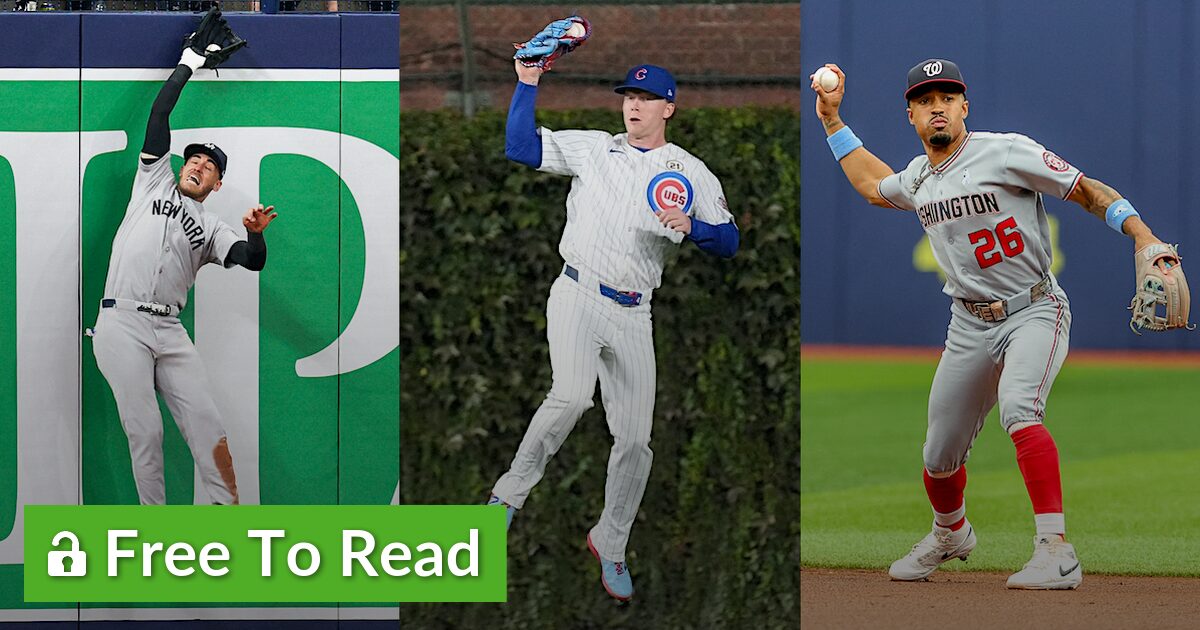
Monday, I published the first half of my ballot for this year’s Fielding Bible Awards, which will be announced at 3 PM ET tomorrow. Today, I’m going to cover my votes for the three outfield positions and pitcher, as well as the best multi-positional defenders, defensive player of the year, and defensive team of the year.
If you’re curious about the methodology I used to help guide my voting, you can read about it in Monday’s article, but here’s a quick refresher: I used a weighted blend of DRS, FRV, and DRP (the three flagship public defensive metrics), with the weights based on how well each metric did on reliability and consistency. That gave me an initial rough order at each position. From there, I used my own insights gleaned from both statistical and video deep dives on individual players, as well as the copious amounts of baseball I watched this year, to assemble my final rankings. I deferred to the defensive metrics when the gaps were big, but for close calls, I leaned heavily on my own judgment.
That’s a fair number of words, and there will be a lot more as I go through each of these positions, so let’s get right to it, starting with left field.
Left Field
1. Cody Bellinger
2. Chandler Simpson
3. Jackson Chourio
4. Ian Happ
5. Wyatt Langford
Last year, Bellinger played all over the outfield. This year, he mostly played in left, and he was pretty spectacular. He’s one of the best outfield defenders in the sport, and now that he’s playing full-time at a relatively weak position, he stood out from the pack here. He does it all: great anticipation and route-running, good speed, and a terrific throwing arm. With Steven Kwan now in center, Bellinger is the class of the position, and I didn’t seriously consider anyone else for my first place vote.
That said, were it not for Bellinger, Simpson versus Chourio would make for a great debate over who should be in the top spot. They accrue value in notably different ways and yet grade out similarly. Simpson has one of the worst throwing arms in the game, but he more than makes up for it when the ball is in the air. It’s not a shock that the fastest man in baseball covers a lot of ground, but last year, he posted poor reaction times when the ball was put in play, which really blunted the value of his speed. This year, he’s reacting faster than all but one outfielder (Jacob Young), and while that leads to some inefficient routes, he’s so fast that getting up to top speed quickly more than makes up for it. A common sight this season was Simpson throttling down into a catch that was nonetheless spectacular, because he was worried about overrunning it. The Rays didn’t put him in center, but I wouldn’t be surprised if they do in future years, and I think he’d look even better there.
Chourio isn’t quite as fast as Simpson, but he’s no slouch, either, and he’s a true five-tool player. His throwing arm isn’t as good as Bellinger’s, but it isn’t far behind. Notably, he’s never made a throwing error despite racking up a pile of outfield assists; the Brewers benefited mightily from how hard it was to take extra bases on them this year, and Chourio was a big part of that. I put Simpson ahead of him on my ballot, but ask me on a different day and I might have voted differently. I think both of these guys are amazing.
You Aren’t a FanGraphs Member
It looks like you aren’t yet a FanGraphs Member (or aren’t logged in). We aren’t mad, just disappointed.
We get it. You want to read this article. But before we let you get back to it, we’d like to point out a few of the good reasons why you should become a Member.
1. Ad Free viewing! We won’t bug you with this ad, or any other.
2. Unlimited articles! Non-Members only get to read 10 free articles a month. Members never get cut off.
3. Dark mode and Classic mode!
4. Custom player page dashboards! Choose the player cards you want, in the order you want them.
5. One-click data exports! Export our projections and leaderboards for your personal projects.
6. Remove the photos on the home page! (Honestly, this doesn’t sound so great to us, but some people wanted it, and we like to give our Members what they want.)
7. Even more Steamer projections! We have handedness, percentile, and context neutral projections available for Members only.
8. Get FanGraphs Walk-Off, a customized year end review! Find out exactly how you used FanGraphs this year, and how that compares to other Members. Don’t be a victim of FOMO.
9. A weekly mailbag column, exclusively for Members.
10. Help support FanGraphs and our entire staff! Our Members provide us with critical resources to improve the site and deliver new features!
We hope you’ll consider a Membership today, for yourself or as a gift! And we realize this has been an awfully long sales pitch, so we’ve also removed all the other ads in this article. We didn’t want to overdo it.
In case you didn’t read all that, here’s the short version. Membership includes:
✓Ad-free browsing
✓Unlimited FanGraphs & RotoGraphs articles
✓Historical & platoon projections
✓Leaderboard & player-page stat heatmaps
✓One-click data exports
✓Customizable player-page dashboards
✓Dark & Classic site modes
✓Weekly Members-only mailbag
✓FanGraphs Walk-Off, your year in review
✓Optional homepage photo removal
✓Gift articles to non-Members
✓Full postseason coverage
Happ seems to get a down-ballot vote from me every year, though I’ve never come close to putting him at the top of the list. To me, the three guys ahead of him here are center fielders playing out of position, while he’s more of a classic left fielder. He isn’t that fast, and he doesn’t have huge arm strength, but he maxes out his talents by getting off the ball quickly and understanding his own talents perfectly. One way I think about it: Statcast has him 199th in arm strength and sixth in run value from his arm. That’s because he holds runners on with aplomb; baserunners choose discretion over valor when the ball is hit to Happ, because they know he’s going to be quick to the ball and make an accurate throw.
Finally, Langford was good too, though certainly behind the other four guys for me. With every year he plays the outfield, his reaction times get better; he now gets comfortably above-average jumps, and he excelled coming forward and making diving or sliding catches. He had a down year with his arm, but that’s not all that important in left, so I overlooked it; broadly speaking, it’s great to see a guy who came up with a sketchy defensive reputation turn into an excellent left fielder.
Center Field
1. Pete Crow-Armstrong
2. Ceddanne Rafaela
3. Andy Pages
4. Michael Harris II
5. Evan Carter
These are the best two defenders in baseball – they just happen to play the same position. I watched a ton of both of them this year, almost exclusively for my own enjoyment. Crow-Armstrong led my blended ballot by a fair margin, and I would have put him first in any case. I think this catch was my favorite of his this year, but honestly, you could watch highlight-reel plays for days. He’s blindingly fast, gets the best jumps in the game, and just for fun, he has a great throwing arm too. I don’t quite buy FRV’s contention that he’s 10 runs better than Rafaela in center, but I do think he’s the best guy doing it right now.
Rafaela got my vote for first place last year (and won the award, for what it’s worth), and he was just as good this year. He does it all, just like Crow-Armstrong. He catches everything, and after he does, he unleashes laser beams around the diamond to keep runners glued to their bases. So why PCA in the top spot? For one thing, Crow-Armstrong had 79 plays that Statcast says are less than 90% likely to be made, and turned 65 of them into outs; Rafaela had 74 opportunities and turned 47 into outs. They both look absolutely stellar out there, and truthfully I think I might like watching Rafaela more (it’s hard to go wrong), but PCA’s season was just a standout for me.
Pages, Harris, and Carter are really good defenders. You probably know what Pages and Harris do well; they’re not new to the ranks of the league’s defensive standouts, and Pages had a highlight grab in last year’s World Series just to make sure everyone was paying attention. I put Carter on here over a range of similarly deserving options – Cedric Mullins, Jacob Young, Tristan Peters, Jackson Merrill – even though his throwing arm is a little bit short of those guys, because I was really impressed by his range; he covered for some rough right field defense by marauding over into the gap with great regularity.
Right Field
1. Wilyer Abreu
2. Corbin Carroll
3. Carson Benge
4. Seiya Suzuki
5. Victor Mesa Jr.
I had Abreu and Carroll second and third last year behind Fernando Tatis Jr., and they’ve kept up their excellent form while Tatis had a down year and also spent 400 innings at second base. You know what you’re getting with Abreu. He gets good jumps, runs fairly well at full speed, and has one of the strongest arms in baseball — it’s a classic right field skill set. I’ll also note that he plays very well in Fenway’s spacious dimensions, which seems to give him a boost in several defensive systems; I don’t have the actual guts, but it sure looks to me like Boston right field is systematically a bit over-credited. But playing your home park well matters, and even if I shade down for that, I still think his ability to deter baserunner advancement has him ahead of Carroll.
Speaking of, Carroll has a below-average arm, but that’s the end of the list of his weaknesses in the field. He makes incredible use of his sterling top-end speed by taking off like he was shot out of a cannon at the crack of the bat. His routes aren’t perfect, but that’s by design; he just gets up to full speed as soon as possible and curls his way to the ball. It adds up to highlight reel catches by the boatload, but it also results in a lot of catches that don’t even look impressive because he happened to read them well and starts so quickly. If these guys played left, I’d vote for Carroll, but people run on him a lot, and Abreu is just so good there that I couldn’t get that out of my mind as I voted.
Benge was awesome in his rookie year, and I bet he’ll end up winning this award a few times before all is said and done. He already has the arm talent you’d expect from an elite right fielder, and he’s fast and instinctive enough to play center. Give him a few more reps to round the edges off, and he’s going to be a monster out there. I had to think long and hard about how to order him and Suzuki, who has better defensive metrics across the board. They were pretty close, though, and I just can’t quite get behind the numbers on Suzuki. I don’t think he’s bad by any stretch, but even after watching a bunch of highlights and diving into his metrics in great detail, he seems like an average fielder aside from his arm value. He did rack up a pile of outfield assists this year, and ultimately I think he was the fourth-best right fielder in baseball, but I just couldn’t place him ahead of Benge, who basically seems like an upgraded version of the same skill set to me.
Before Mesa turned heads during the playoffs, he was a defensive terror in the regular season. I almost didn’t believe the stats at first, because he barely logged 500 innings in the field, but on a per-inning basis, he was the best right fielder in baseball by a huge margin. Still, I didn’t feel comfortable placing him first in the same way I had Matt Chapman first at third base after a stellar performance in limited innings. I’m just less confident that the models are evaluating Mesa correctly; he doesn’t have a decade of corroborating evidence like Chapman. But he definitely passes the eye test, his arm is certifiably elite, and I think it’d be a mistake to leave him off the ballot entirely just because he wasn’t in the big leagues at the start of the year.
Pitcher
1. Tanner Bibee
2. Shota Imanaga
3. Michael McGreevy
4. Brent Suter
5. Seth Lugo
This is the position where I feel the least confident in my selections, because there just aren’t that many opportunities to observe pitcher defense; they don’t field all that many innings, and they don’t field all that many opportunities per inning. To compensate for this, I relied heavily on Statcast’s measurement of how well pitchers controlled the running game. Keeping runners stationary doesn’t show up in highlights, but given how rarely pitchers actually field their position, it struck me as the correct skill to reward here. I did give consideration to pitchers who also seem to field their position well, but you won’t find any pitchers on this list who are easy to run on.
So where does that leave us? Bibee, Imanaga, and McGreevy tied for first in preventing runner advancements, and Bibee had the best DRS and also looked the best on the mound, so he got my tie-breaking vote. Suter and Lugo are both excellent at shutting down runners and also graded out well by DRS in other aspects of fielding, so they place as well. I don’t want to pretend like I did a lot more than that here.
Multi-Position Defender
1. Nasim Nuñez
2. Zach McKinstry
3. Joey Ortiz
4. José Caballero
5. Steven Kwan
This was a really tough ballot, because many of the defenders who I’d be comfortable voting for at a single position bopped around the diamond this year. I wouldn’t hate any ordering of these five, who all demonstrated elite defense at important positions. But I had to pick one guy for the top spot, and after a lot of hemming and hawing, I settled on Nuñez, who started the season as Washington’s everyday second baseman but eventually took over at shortstop when the Nats decided that CJ Abrams wasn’t a long-term fit for the position. He does it all, with sure hands, good range, and a sneaky-strong throwing arm for someone his size. He switched positions mid-year without much warning and acquitted himself well. It’s a testament to how much the Nats think of Nuñez’s glove that he racked up 493 plate appearances with a .535 OPS; he was just that good in the field.
Ortiz and Caballero both had very similar cases. They were elite defenders on the left side of the infield who flipped back between third and short throughout the year. Caballero also played the outfield a bit, but not well, so I didn’t give him any bonus credit for that. I think they’d both contend for a Fielding Bible Award with a full season of work at third base, though I don’t think that either of them (or Nuñez) would get my top vote at shortstop. I picked Nuñez over these two because he played the most innings in the field, with very similar per-inning numbers, but I think Ortiz is the strongest defender in the long run.
My second place vote didn’t go to either of those guys, though; it went to McKinstry, who is probably the favorite for this award since he was a true Swiss Army knife this year, with plus defense in 500 infield innings and 500 outfield innings. His huge throwing arm made him a fearsome right field weapon, and he also acquitted himself well at second base and shortstop, allowing the Tigers to fit different personnel groups onto the field depending on their day-to-day needs. If I were more confident in his outfield defense, I’d have had him in first place, but I just couldn’t convince myself of his range (I have no questions about the throwing arm, to be clear).
Finally, Kwan probably played himself out of the award in left field by being good enough to play center, but he didn’t quite hit the bar that the top four did here. I do think he was the best multi-positional outfielder in the league this year, which is why he’s in my top five as the player whose skill set differs from the other four by quite a bit.
Defensive Player of the Year
1. Pete Crow-Armstrong
2. Ceddanne Rafaela
3. Dillon Dingler
As I mentioned in the center field section, Crow-Armstrong and Rafaela were the two best defenders in baseball this year. It’s difficult to evaluate infielders relative to outfielders, and that’s without getting into catcher defense, but I feel strongly that PCA and Rafaela were more valuable to their teams than anyone else on the ballot. The eye test would surely agree with me; I saw more highlights from these two than the rest of these guys put together. I don’t need to keep belaboring the point; PCA and Rafaela played out of their minds this year, and it was a joy to watch.
I gave the last spot on my ballot to Dingler, who was clearly the best defender at the most important defensive position. I didn’t think that his level rose to that of the two center fielders, but in a year that had slightly less incandescent defense on the grass, I would have been happy placing Dingler first on the ballot. He’s both excellent and well-rounded, just what I like in my elite defensive catchers. But this wasn’t his year; Crow-Armstrong and Rafaela were so good that Dingler was always playing for third in my mind. I gave some consideration to Brice Turang and Masyn Winn, my top selections at the other up-the-middle defensive positions, as well, but Dingler finished a hair ahead of them for me.
Defensive Team of the Year
1. Tampa Bay Rays
2. Chicago Cubs
3. Los Angeles Dodgers
This award debuted last year, and I’m still not entirely settled on how to determine a winner. Is it the team with the most good defenders? The team that puts their defenders in the best positions to succeed? Some blend? Should we give extra credit for synergy between teammates? Is that even measurable? I ended up choosing based on a blend of what the various defensive systems said, how teams did at turning batted balls into outs, and, well, vibes. I considered to what degree I felt like I was watching an elite defense when I watched each team, for lack of a better way to put it.
That led me to put the Rays in the top spot. I can’t get enough of their skilled outfield group, with four different plus defenders rotating around and generally turning opponents’ fly balls into outs at a ludicrous clip. I enjoyed their three-way split in catcher playing time between three backstops I think are pretty good. I thought Taylor Walls was incredible at shortstop, and I give Junior Caminero a lot of credit for vastly improved defense at third base. The Rays had a ton of different players rotate throughout the year. They held opponents to the lowest BABIP in baseball by a large margin. When I watched the Rays, I just felt like they were going to shut the other team down, or make a play to flip an inning from dangerous to benign.
The Cubs led baseball in all of the various advanced defensive metrics, and they’re likely to take home a pile of individual defensive hardware when all is said and done. I had Cubs on the ballot at six different positions, including defensive player of the year. It’s hard to go wrong with Crow-Armstrong, Nico Hoerner, and Dansby Swanson anchoring your defense, not to mention Alex Bregman providing Gold Glove-level support at third. But I thought they had some holes, particularly at catcher and first base. I also just didn’t get the “everything is fine because the team is so good” feeling here that I did elsewhere – I more got the feeling that PCA was unstoppable. Splitting hairs? Perhaps. But it was enough to give a slight edge to the Rays at the end of the day.
Finally, the Dodgers didn’t have a ton of standouts, and they probably won’t win a single Fielding Bible Award, but I thought they embodied the “team” aspect of team defense. They’re kind of old, and they play some sketchy defenders to shoehorn more good bats into their lineup, but somehow, the whole was more than the sum of its parts. The Dodgers turned batted balls into outs better than all but one team in baseball. They make it all work with little access to the DH spot thanks to Shohei Ohtani, a luxurious overall problem, no doubt, but a tricky one on defense. If we’re putting the emphasis on “team” here, they deserve a mention, because it’s frankly unbelievable that they remain so good at defense given their personnel.