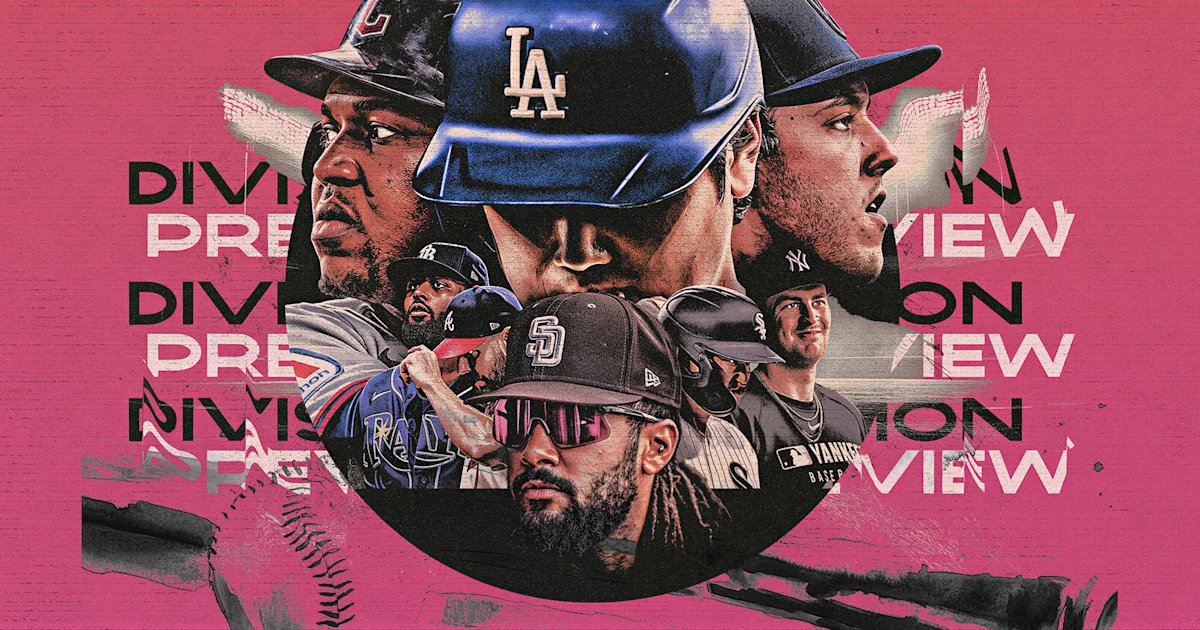
Four postseason teams are out. Eight contending teams remain. It’s on to the division series.
All four best-of-five series begin Saturday. Let’s break it down.
The second round of the MLB playoffs begins Saturday.
(Bruno Rouby/Yahoo Sports)
No. 6 Chicago White Sox vs. No. 2 Cleveland Guardians
How they got here
White Sox: Chicago entered the year as the ultimate underdog, with preseason playoff odds of approximately 1%, according to most projection systems. But the White Sox demonstrated early on that they were no longer in rebuild mode and instead ready to compete in the wide-open American League. Even when Chicago got swept opening weekend in Milwaukee by a combined score of 29-10, Brewers manager Pat Murphy went out of his way to heap praise on the opponent, foreseeing the White Sox as legitimate contenders in the AL Central.
Advertisement
Murphy was onto something: The White Sox spent the majority of the season at or near the top of the division standings, ultimately coming up just short behind Cleveland but still snagging the final wild-card spot. And after taking care of business with a two-game sweep in the wild-card series in Houston, the White Sox have guaranteed themselves at least one postseason home game for a fan base that surely did not expect to be hosting in October this year. Plus, Chicago has a chance at revenge against the Guardians club that chased them down for the division title.
Guardians: It was another scorching September for the Guardians, who struggled to find momentum early on and fell five games below .500 as late as Aug. 19 before catching fire down the stretch, surpassing the White Sox and claiming their seventh AL Central crown in the past 11 seasons. Aiding Cleveland’s strong second half was its uncharacteristically aggressive trade deadline, which featured the addition of two veteran bats in Jo Adell and Nathaniel Lowe, plus an All-Star starting pitcher in Foster Griffin, who has helped stabilize the rotation.
But the real story of Cleveland’s season is its terrific rookie class, headlined by left-hander Parker Messick, who is slated to start Game 1 on Saturday, and a pair of lefty bats in Chase DeLauter and Travis Bazzana. These consequential contributors have helped mask a frustrating campaign for face of the franchise José Ramírez, who missed more than a month due to a hamate injury and has rarely looked like his All-Star self for prolonged stretches this season.
The Guardians are typically much younger than their competition in the postseason, but their first opponent this year is similarly built — Chicago’s rookie class is also stacked — which should make for an extremely fun series filled with young talent announcing themselves in the postseason for the first time.
Advertisement
X-factors
White Sox: 3B Miguel Vargas
It’d be understandable to highlight hitters with extreme boom-or-bust profiles such as Munetaka Murakami and Colson Montgomery, but I’m more inclined to keep the focus on Chicago’s best overall bat. Miguel Vargas was one of just three hitters in the majors this season to hit 30 homers and 30 doubles and draw 100 walks, along with James Wood and Yordan Alvarez, and his sterling underlying metrics indicate that this breakout season was no fluke. Vargas also performed well against the Guardians this year, hitting .304/.424/.565 with three homers and more walks (11) than strikeouts (10) across 13 games. In a lineup filled with rookies and high-whiff hitters, Vargas needs to provide consistent quality at-bats, especially against Cleveland’s best arms.
Advertisement
Guardians: Whoever starts Game 3
Because they earned the bye, the Guardians are in excellent shape with their pitching plans, as top arms Messick and Gavin Williams could combine to cover Games 1, 2, 4 and 5 on regular rest. But it’ll be fascinating to see whom the Guardians give the ball for Game 3 in Chicago in front of what promises to be a raucous Rate Field crowd. Manager Stephen Vogt said Thursday that they’re still working through their options, and Cleveland could go a few different directions.
Opening Day starter Tanner Bibee has made five postseason starts the previous two seasons, but he took a step back this season and posted a 7.36 ERA in September. Griffin has delivered some gems but also some clunkers since arriving at the deadline. Lefty Joey Cantillo has also been hot-and-cold for much of the year, though he has dominated more recently when entering the game following an opener. You can talk yourself into (or out of) any of these options, and it might depend on how the first couple games unfold, but this is a storyline to watch for Cleveland.
Subscribe to Yahoo! Sports MLB on YouTube for videos, podcasts and more
How they win
White Sox: The long ball can carry teams a long way in the postseason, and in this matchup, Chicago has the obvious edge in the home run department. The White Sox finished fifth in MLB in homers this season, with 211; the Guardians went deep only 162 times, which ranked 27th. Murakami, Montgomery and Vargas all hit 30-plus homers, while Cleveland’s home run leader was Angel Martinez with just 18. The Guards proved down the stretch that they can score runs consistently without outlier slugging — and deadline addition Adell is a credible home run threat — but the Sox undeniably have more of a knack for clearing the fence. Heck, even Chase Meidroth is hitting moon shots lately, and if Chicago’s lineup continues to build confidence, the Guardians’ pitching staff could have difficulty keeping them in the ballpark. Those game-changing swings could prove to be the difference in a short series like this.
Advertisement
Guardians: Even with the question of the plan for Game 3, however you slice it, Cleveland enters this series with a considerable edge on the mound. Avoiding a third game in Houston was important, but the White Sox still asked a lot of their best arms across two wild-card games, including top reliever Grant Taylor throwing a career-high 54 pitches on Tuesday, Jordan Hicks appearing in both games and top starter Sean Burke throwing four innings Wednesday, which could render him unavailable for Game 1. Cleveland, meanwhile, can attack right out of the gate with two of the best starting pitchers in the American League in Messick and Williams and follow with a fully rested bullpen. And it’s not just an advantage in the early innings; the Guardians also have one of the top game-enders in the league in Cade Smith looming on the backend. This collection of arms presents quite the contrast to the undermanned pitching staff the White Sox just faced in Houston, and it should minimize what Cleveland’s offense needs to do to come out on top in this series.
Series prediction: Guardians in 5
These teams played each other awfully close in the regular season. The White Sox won seven of 13 games, and the aggregate score was 58-57 in Chicago’s favor, with seven of the contests decided by one run and four ending in walk-off fashion. Those narrow margins suggest this series could go the distance, which makes me inclined to tilt slightly toward the team with home-field advantage and more experience navigating high-stakes October games. Chicago is fully capable of pulling the upset here, and based on how the season series played out, it arguably wouldn’t be much of an upset. But I’ll lean toward the Guardians here on account of that elevated experience and their advantage on the mound. — Shusterman
No. 4 New York Yankees vs. No. 1 Tampa Bay Rays
How they got here
Yankees: New York finished five games back of Tampa Bay in the division but walloped the Red Sox in a wild-card laugher to set up a showdown of the consensus two best teams in a shallow American League. It was an emphatic, thorough performance from the Yankees offense, which scored nine runs in each game with an injured Aaron Judge off the roster and a compromised Giancarlo Stanton on the bench. The starting pitching was arguably even more impressive, with Cam Schlittler and Max Fried combining for 16 strikeouts and just one run allowed across 12 ⅓ innings of work. This team is rolling at the right time.
Advertisement
Rays: What a season it was for a Tampa Bay team that entered 2026 as most people’s fifth choice in a stacked AL East. Instead, the Rays won 98 games behind a high-contact offense, a top-three rotation and the dream-stealing exploits of Junior Caminero. “How are the Rays doing this?” quickly turned to “Can they keep this up?” which morphed into “Will it work in October?” It’s a legitimate question, considering the dearth of obvious stars behind Caminero. But there’s also a chance that Tampa’s crisp, low-mistake, fleet-footed style of play translates wonderfully to the high-stakes world of postseason baseball.
X-factors
Yankees: Cody Bellinger
The glazy-eyed lefty provided the knockout blow against the Red Sox in the wild-card round with a high-arcing, three-run crank into the Yankee Stadium short porch. Boston had intentionally walked Ben Rice to get to Bellinger, and Bellinger made them pay. That’s why, even if Aaron Judge returns for the ALDS, Bellinger will remain a critical character in the New York lineup. On a team full of high-whiff, high-strikeout hitters, the 2019 NL MVP is a much more Rays-coded character who can work a long at-bat and grind a pitcher down. Tampa Bay smothered Bellinger to a .520 OPS across 49 regular-season plate appearances this season. He’ll need to be a bigger factor than that for the Yankees to win this series.
Advertisement
Rays: Junior Caminero
It’s cliche because it’s true: To win in October, you need special players to do special things. Caminero is exceptional for a multitude of reasons, the most important of which is his ability to clobber baseballs harder than almost anybody else on Earth. But Caminero’s comfort in and thirst for the spotlight might elevate him to a whole other plane in this postseason. His dramatic, title-winning long ball in the Dominican Winter League a few years ago produced one of the greatest baseball highlights of all time. Most players want to be great; this dude wants to be legendary.

The Cubs, Red Sox, Astros and Phillies are out. The Brewers, Dodgers, Guardians and Rays are up.
(Hayden Hodge/Yahoo Sports)
How they win
Yankees: By continuing to lean on their starting pitching. It’s a testament to New York’s outrageous rotation depth that the 2023 Cy Young and a dude making $27 million with a 2.67 ERA didn’t get starts in the wild-card round. Expect Gerrit Cole and Carlos Rodón to feature prominently against Tampa Bay; one will probably start Games 1 and 4, while the other will slide to a Swiss Army bullpen role. Cam Schlittler, the presumptive AL Cy Young, will start Games 2 and 5. Max Fried will handle Game 3. The Yankees lost Game 1 of last year’s ALDS in large part because they had to deploy a bullpen game. This team doesn’t have that issue.
Advertisement
Rays: Everybody not named Junior Caminero grinds at-bats and gets on base. If the Rays can work pitch counts and get Yankees starters to the showers in the fifth or sixth innings, instead of the seventh or eighth, they’ll get to pick away against New York’s bullpen underbelly. It’s difficult to envision Tampa Bay pouring buckets of runs on Schlittler, Fried and Co., but the Rays took the season series against the Yankees for a reason. This team can ball and won’t be intimidated by the pinstripey-ness of it all. Expect The Trop to be rocking on Saturday.
Series prediction: Yankees in 4
It’s impossible to pick against New York’s rotation right now, considering how overwhelming it looked against Boston. I think the Rays will battle out a Game 1 win if the Yankees start Cole, but the Yanks will come roaring back behind Schlittler in Game 2 and finish things off in the Bronx. — Mintz
No. 4 San Diego Padres vs. No. 1 Milwaukee Brewers
How they got here
Padres: If you didn’t know why the Padres were the hottest team in baseball over the past month, look no further than their drubbing of the Chicago Cubs in the wild-card round. San Diego outplayed Chicago in every aspect of the game. That started with the production from its superstars, Fernando Tatis Jr. and Manny Machado. And backing up that offensive fire power, San Diego’s pitching showcased its dominance as well. Right-hander Michael King shut down the Cubs’ offense with seven innings of one-hit ball in Game 1, and the Padres’ bullpen provided 5 2/3 shutout innings in Game 2 to put the series away.
Advertisement
Brewers: Another year, another season in which the Milwaukee Brewers’ lack of marquee names doesn’t mean a lack of success. Milwaukee steamrollered the NL Central, which has become a common theme in recent years. Among the things that went well for the Brewers was their dominant pitching, led by Jacob Misiorowski, who will likely be the NL Cy Young Award winner this winter. But it wasn’t just pitching. The Brewers’ offense was a juggernaut in its own right, ranking second in MLB in runs scored, despite ranking second-to-last in homers. And after finishing the regular season with a franchise-record 103 victories, the Brewers are looking to ride their successful year to an even better postseason, with hopes of making their first World Series appearance since 1982.
X-factors
Padres: 3B Manny Machado
The Padres go as Fernando Tatis Jr. goes, but if there’s one hitter whose impact could mean more in this series, it’s Manny Machado. His regular-season numbers weren’t what we’re used to seeing from Machado in his career, but the Padres’ franchise leader in homers showed in the wild-card round that he’s still dangerous. If the Brewers are careful with Tatis, who is one of the best postseason hitters ever, that will leave Machado with opportunities to be a game-changer. And with one swing of the bat, San Diego’s third baseman can swing the series in the Padres’ favor.
Advertisement
Brewers: SP Jacob Misiorowski
If you’re trying to slow down the hottest team in baseball, it helps to have the best pitcher in baseball. Jacob Misiorowski dominated the entire league during the regular season, and while it’s harder for a pitcher to take over a series than it is for a position player, an ace like The Miz could. Misiorowski’s start in Game 1 will be crucial for Milwaukee’s success. If the Brewers’ ace can set the tone in this series, it’ll create a trickle-down effect for the rest of Milwaukee’s starters. Misiorowski is the Brewers’ engine. Their success in this series and the entire postseason runs through him.
How they win
Padres: San Diego showed in the first round that if its stars come to play, there’s no stopping this team. And that’s the Padres’ most likely route to the NLCS. Milwaukee can’t match San Diego’s star power or firepower, and if Tatis, Machado and the Padres’ offense do what they’ve done over the past six weeks, they’ll run through the Brewers, no matter how well Misiorowski pitches. And with a bullpen that’s the envy of baseball, the Padres can shorten any game and shut down their opponent, regardless of how their starters do.
Advertisement
Brewers: Neutralizing the Padres’ stars is doable with elite pitching, and that’s how the Brewers are built. Misiorowski and Logan Henderson keeping San Diego’s hitters at bay in the first two games will give the Brewers the confidence to go into Petco Park and take this series. And with a bullpen that was third in ERA this season, Milwaukee can shorten games almost as well as the Padres. Offensively, Jackson Chourio has shown that he loves the big stage. With a 1.044 OPS and four homers in 12 postseason games so far, the Brewers’ 22-year-old star is made for the moment.
Series prediction: Brewers in 5
This matchup has a chance to be one of the best series of this postseason. And with the hottest team in baseball meeting the team with the best record this season, it’s a case of an unstoppable force and an immovable object. There will likely be big swings of momentum by both sides. Milwaukee’s pitching holds the advantage, but San Diego’s offense has the edge. In the end, the Brewers’ ability to throw the best pitcher in the sport twice in the series and manage the middle games with its strong bullpen will make the difference. — Dorsey
No. 3 Atlanta Braves vs. No. 2 Los Angeles Dodgers
How they got here
Braves: Atlanta bounced back from a deflating Game 2 wild-card defeat against Philadelphia with a resounding Game 3 win over their division rivals. Three shutdown innings from an improbable source, 32-year-old southpaw Ray Kerr, set the tone. Michael Harris II hopped on a first-inning Aaron Nola sinker for a three-run tank, and the rest was epilogue. The Braves head to Los Angeles feeling good, with their division rival and October bugaboo finally vanquished. A familiar foe awaits.
Advertisement
Dodgers: Baseball’s new Evil Empire cruise-controlled its way to a 100-win season. As always with LA, it wasn’t devoid of drama. Big free-agent signing Kyle Tucker sleepwalked through the first five months. Shohei Ohtani stopped pitching and then stopped hitting and then stopped playing. Edwin Díaz was a catastrophe. Freddie Freeman had one extra-base hit in September. But for all the hand-wringing and worrying about Los Angeles’ roster of aging stars, they begin this three-peat quest with an extremely formidable group that includes deadline headliner Tarik Skubal.
X-factors
Braves: Ronald Acuña Jr.
Atlanta’s main man didn’t do much against Philadelphia, going just 1-for-9 with four walks and a single. The Braves probably can’t afford to have Acuña disappear against Los Angeles’ magnificent pitching staff. It has been said a million times, but Acuña having been sidelined for Atlanta’s 2021 World Series run creates such a fascinating dynamic. He has a ring, but he doesn’t feel like it’s fully his, fully earned. And since his Game 3 grand slam against Walker Buehler in 2018, Acuña hasn’t really delivered a signature October moment. The stage is set.
Advertisement
Dodgers: Shohei Ohtani
Is it reductive and overly simplistic to label Ohtani an X-factor? Perhaps, but this dude hasn’t been a dynamic, intimidating offensive force for two months. He posted a .689 OPS from Aug. 7 to Sept. 7 while slogging through various physical ailments. Then he went on the IL for a stretch before coming back to go 5-for-21 across five games with just one extra-base hit. Doubting Ohtani feels like a fool’s errand, but this guy has to physically decline at some point. There’s certainly a chance we’re seeing the beginning of that.
How they win
Braves: By getting meaningful innings from pitchers other than Chris Sale. The offense needs to do its part as well, but the longer series means the Braves won’t be able to lean on their ace quite as heavily. How skipper Walt Weiss and Co. choose to navigate the games not started by Sale or Tyler Mahle will dictate this showdown. Atlanta has the bullpen to pull off this high-wire act, but it won’t be easy, and more unsung heroes like Ray Kerr will need to emerge.
Advertisement
Dodgers: Lean, lean, lean on the starters and lean on the starters some more. Los Angeles won the World Series last season because its rotation rose to the occasion. That will need to happen again because this Dodgers offense is notably less intimidating than last year’s group, at least on paper. Will Smith doesn’t look like the same player. Neither does Freddie Freeman. We’ve already talked about Ohtani. Los Angeles wins this series by riding Yoshinobu Yamamoto, Skubal, Blake Snell and Tyler Glasnow. It’s not a bad plan.
Series prediction: Dodgers in 4
Even if Chris Sale starts multiple games, the Dodgers still hold a significant pitching advantage. Yamamoto is coming off one of the greatest postseasons of all time. Skubal looks like a top-three pitcher in the world again. And then you have to face Blake Snell in Game 3. I’m definitely worried about Los Angeles’ offense, but I don’t think the Braves have the starters to take advantage of that particular weak spot. — Mintz