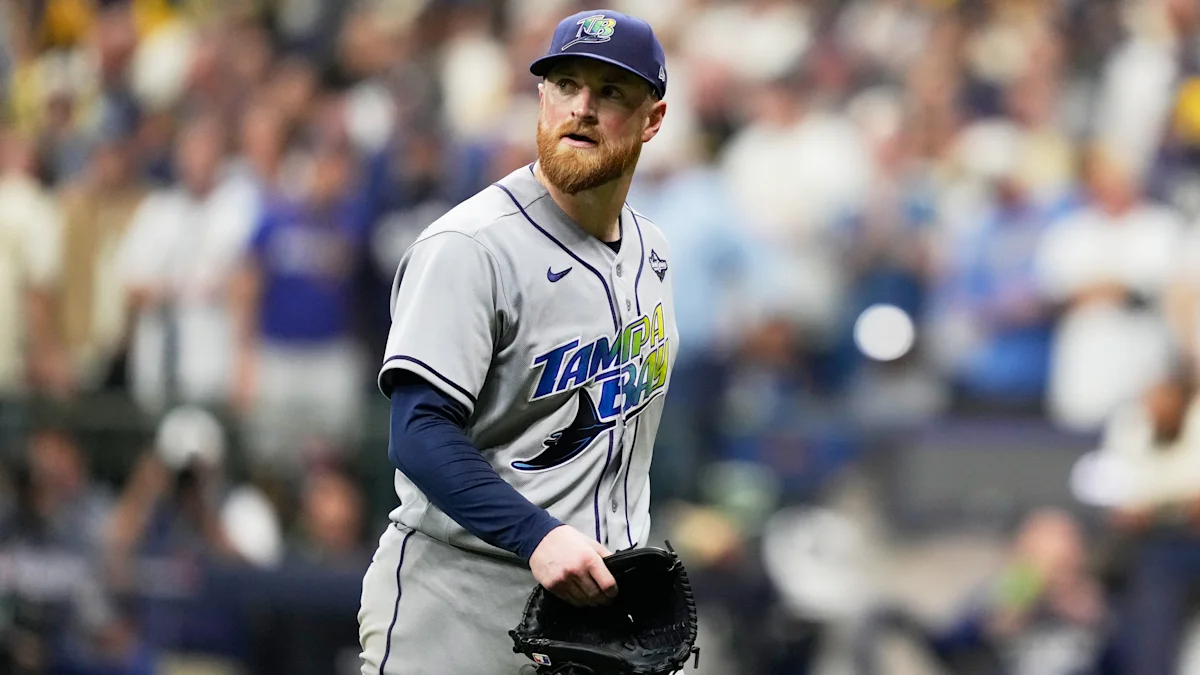
MILWAUKEE – Coming off a disappointing loss in Game 1 of the World Series, the Tampa Bay Rays still looked to be in a solid position entering Game 2 on Saturday, with ace Drew Rasmussen on the mound and the bullpen fully rested for Milwaukee’s best relievers, who had to cover four innings on Friday.
This advantage was further enhanced on paper when the Rays stranded Brewers rookie Logan Henderson in the top of the first inning Saturday. No team allowed fewer first-inning runs in the regular season than Milwaukee, scoring 60 times in 162 openers. But when Liam Hicks lined a misplaced grounder from Henderson 411 feet to second in right field, it was 4-0 Tampa Bay before Rasmussen had even taken the mound.
Advertisement
You couldn’t have drafted a better start to the team looking to get to the series. But against these Milwaukee Brewers, the start only means so much. And at the end of the night, which was fourfold in the first scurvy, as a completely inexplicable opening act, eight figures follow through the rest of the tables. Along the way, a flood of dark breweries has opened the door for brewing companies ever wanting to wander through. The result? But another Milwaukee comeback and 5-4 final, which sends the series to St. Petersburg with the Rays 2-0.
“Don’t worry about everyone [at-bat]all the pitch They put up a lot of fight and they went all nine innings,” Rays outfielder Chandler Simpson said afterward.
The Brewers’ punch came quickly after Hicks’ homer, with Rasmussen needing 29 pitches to navigate a four-hit first inning, including RBI singles from William Contreras and Garrett Mitchell that cut Tampa Bay’s lead to 4-2. The inning also included a line drive from Brice Turang that swung the bat at 108.5 mph — the third hardest hit ball Rasmussen has allowed this season. The six runs combined were the most in the first inning of a World Series game since 1993, suggesting he was a very lazy treasure. but it is a much more serious offense to come from it.
Advertisement
Rasmussen responded with a 1-2-3 second, but even that score brought some stress. Jackson Chourio struck out six before ending the offering in the 11th inning, pushing Rasmussen’s pitch count to 49. The right-hander kept the heart of Milwaukee’s order quiet in the third, but allowed another 18 pitches.
“Kudos to them,” Rasmussen said afterward. “Woe is composed of bats, and they do not cease to compete, for what is real.”
In the fourth, down the line the Brewers mounted more pressure as Rasmussen’s command began to wane. Rookie Cooper Pratt drew an 0-2 single with a walk. Sal Frelick followed with a sharp single that left the bat at 105.4 mph — his hardest ball since June 7 and a harbinger of even bigger swings to come.
Advertisement
Then the wheels really started to fall off for Tampa Bay. David Hamilton hit a ball down the right field line that trickled under the ball and through the legs of first baseman Jonathan Aranda, allowing Milwaukee’s third run to score. If Aranda could clean up the field, he would have time to throw Pratt at home. Instead, it represented just the second mistake the Rays erased and the first since ALDS Game 3 against the Yankees.
“I felt like I was falling behind too often to wait for good results,” Rasmussen later said. “And then from there they found that they were able to find some hitters and holes.”
Rasmussen got one more out before a walk to Jake Bauers ended his night, as manager Kevin Cash called on lefty Cam Booser to take on Christian Yelich with the bases loaded. After completing just 3 innings, Game 2 marked Rasmussen’s shortest outing since the July 9 clunker in which he allowed six runs and just seven hits against the Yankees. He went at least five innings in each of his last 11 regular-season starts; The Rays have won all 11 of those contests.
Booser retired Yelich to keep Tampa Bay’s lead intact. But Rasmussen’s first-born exit meant finding more than 15 rays from a bullpen that became increasingly unstable as the season progressed.
The lead pressure of the major building manifested itself in the form of some reckless aggressiveness at the top of the sixth floor. With two outs and Hicks on second base, Victor Mosa Jr. I ran into one past shortstop Pratt. Chourio, playing fairly shallow, backhanded the ball into left field before Hicks even reached third, but third-base coach Brady Williams drove Hicks home anyway. Chourii’s shot to catch Contreras beat Hicks by several steps. The inning was over, and the Brewers were enjoying another moment in the dugout.
Advertisement
A sellout crowd of 43,245 at American Family Field could feel the latest comeback treatment from Milwaukee as Ian Seymour took the mound for the bottom of the sixth. And after nine pitches to Frelick, the game was tied. Seymour alternated between fastballs and sinkers until Frelick smashed a 92.9-mph four-seamer over the center-field wall for a blown run that made it 4-4. The Brewers nearly handled the lead for a few batters, when a miscommunication between Simpson and shortstop Taylor Walls led to Simpson’s attempt to catch Simpson, which should have been a Yelich flyout.
“You just mixed up what happened that usually doesn’t happen,” Simpson said later.
Reliever Tyler Wells came on and got out of the frame with the game still tied, but when he returned from the trade, Rays star Junior Caminero showed some uncomfortable words in the dugout.
“Just trying to help the team, keep our heads up … just trying to create some energy,” Caminero said through interpreter Kevin Vera when asked about that moment postgame. But he emphasized that it was more than just talking about the flag – the intended message was clear.
Advertisement
“Let’s make things right,” he added. “We didn’t do our job at that moment. And against Milwaukee, if you give up outside, they’re going to use it against you.”
Not every mistake came back to bite Tampa in the first two games of the series. But given how the Brewers’ bullpen performed this October — even when Henderson exited after three innings, manager Pat Murphy had quality options to turn to — to break up scoring opportunities or give Milwaukee’s bats additional chances they’re looking for trouble. Ultimately, the Brewers tend to look for the go-ahead run. In Game 2, it came courtesy of Pratt, who had an RBI single in the bottom of the seventh to make it 5-4.
Just like in Game 1, the Rays had one more scoring chance in the final frame of Game 2, when Jonny DeLuca led off with a double against Aaron Ashby. But Ashby made sure DeLuca finished the game by getting on base as he gave up the next three batters for the Brewers’ final victory.
Advertisement
The series now moves to Tropicana Field, where the Rays will once again have a strategic mission, with a confident and out-of-shape veteran, Freddy Peralta, lifting the ball for Game 3 against another Milwaukee rookie, Robert Gasser. But unless the Rays are better in all facets of the game against the Brewers firing on all cylinders, it doesn’t matter how the matchup looks on paper.
“We just got to clean it up,” DeLuca said postgame. “I think now we can speed up the game, and we can just slow down and do jobs and clean everything in all levels of the game.”
“We’re going to dig deep, and we’re going to compete from here,” Rasmussen said. “I think we need to understand what’s ahead of us and what’s to come.”
Perhaps the best thing about radio is that the memory is short right now.
“I’ve already forgotten about these two days,” said Caminero. “The series now, in my mind, starts on Monday.”